New
Evidence on the Lewis and Clark Air Rifle – an “Assault Rifle” of 1803.
Keywords:
Lewis and Clark, Meriwether Lewis, William Clark, Lewis and Clark Air Rifle, Lukens,
Beeman Girandoni, Girardoni, Gilardoni, Girandony, G, Air Gun, Airgun, Military, Repeater,
Repeating, Rodney, Expedition, Sioux, Brunot Island, Voyage of Discovery, Corps of
Discovery, Cowan, Keller, Carrick, Currie, Baker,
Baer, Hummelberger,
Eichstädt, Stewart.
By Robert D.
Beeman Ph.D.[1]
Based on the author's research and publications since 1976 and our Lewis and Clark website established here 23 March 1999. Basic new discoveries announced on this website on 19 March 2005. Latest update of this chapter 15 May 2008.
For additional information on the Lewis Airgun, related guns, and the reproduction of these guns, click on the Austrian Large Bore Airguns and the We Proceeded On to the Lewis Airgun III sections of this website.
SEE the notice about the surprising donation of the Beeman/Girandoni airgun at the end of this section! And see the note near the end about what publications around the world have been saying about the Beeman/Girandoni airgun!
INTRODUCTION
As elaborated in the previous chapter, the search for the air
rifle carried by Meriwether Lewis in 1803-06 seems to have been started over 50 years ago by Charter Harrison (Harrison, 1956a, 1956b, 1957), America’s
first major airgun collector. That was followed by Roy Chatters (1973, 1977) and
Henry Stewart Jr. (1977, 1982). As also noted, a meeting in Stewart’s gun room
in January 1976 inspired the author to continue the search for the next 32+
years. After Stewart's last comments on the matter in 1982, Mrs. Beeman
and I continued that search and study virtually alone for the next 20 years, producing several publications
(Beeman 1977, 1999, 2000, 2002a, 2002b, 2004a, 2004b, 2005a, 2005b, 2006) and,
for many years, posting a large Lewis and Clark Airgun section on our
website (www.Beemans.net). By sheer coincidence, our acquisition of
a Girandoni air rifle, Girandoni air pistol, and several Girandoni-system
airguns in the 1970s also ignited a passion for the Girandoni-system airguns and
we studied and collected them, along with many other antique airguns, around the
world for over three decades.
In 2002, Mike Carrick brought attention to a tiny passage in Smith and Swick’s
recent (1997) transcription of an 1803 travel diary of one Thomas Rodney which
described Lewis handling a gun which, according to his description, obviously was a Girandoni-system airgun.
After a brief period of acceptance of this idea, I, and many other Girandoni and
Lewis and Clark students, came to feel that an astute person would find it much
more logical to reject Rodney’s report as spurious (Beeman, 2004). Based on the
best information known at that time, including many details and images from the
outstanding work by the British Girandoni students, Colin Curie and Geoffrey
Baker (2002), I used our specimen of a Girandoni military repeating air rifle to
illustrate our repudiation of the idea of Lewis’ airgun being a Girandoni
(Beeman 2002 website and Beeman Mss., 2003 -published 2004).If the above series were compared to telling the story of the WW2
Pacific Campaign then, after considering many great battles, we would finally
come to the discovery and use of the atomic bomb.
The bombshell in this present series was a startling series of discoveries, during November 2003 to March 2005 by Ernest Cowan and Richard Keller in their shop in Chambersburg, Pennsylvania. Finally, after over two hundred years, Cowan and Keller claimed that they have found the Lewis airgun and, after severe consideration, that conclusion has become the core of a consensus of Ernest Cowan, Richard Keller, Colin Currie, Geoffrey Baker, myself, and a wide group of other arms experts. Telling more in this introduction would slight the significance and details of the discovery and the consensus, due to lack of perspective, and it would detract from what I hope will be the reader’s enjoyment of engaging in our “mystery” approach which reveals these amazing new findings, clue by clue, and explains and expands our considerations of each point. The new evidence about the Lewis airgun adds a late, but dramatic and revolutionary, twist to the decades long story of this gun.
The latest developments in the Lewis Airgun story were first publicly announced by Ernest Cowan, Richard Keller, and Robert Beeman at the famous Baltimore Antique Arms Show on March 19-20, 2005. The distinguished judging panel of that show awarded the Beemans the “Best Gun of Show” award for the Beeman Girandoni. The show's “Best Exhibit” award was presented to Cowan and Keller for their superb presentation of the Lewis and Clark airgun, and the Lewis and Clark "Short Rifle" firearm. The airgun findings were presented to international view on March 19, 2005 by being added to the Lewis Airgun sections which had been running for many years on the www.Beemans.net website. Announcement (Beeman, 2006) of the apparent discovery of the Lewis airgun and the apparent identification of the Lewis and Clark short rifle (Cowan and Keller, 2006) were both published in the May 2006 issue of We Proceeded On, the official publication of the Lewis and Clark Trail Heritage Association . The new information also has personally been presented to gun collecting clubs and other interested groups in the northeast USA by Ernest Cowan and Richard Keller, and to a far lesser degree, by National Firearms Museum Curator Phillip Schreier and the author.
The first three of the above sources largely have been the bases for several articles, including Saunders (2006), Schreier (2006), Eichstädt (2007), and Beeman (2007), which have popularized these latest airgun discoveries and their significances. These short reports were extremely condensed and some were heavily edited by the publishers. It was inevitable that some details would be slighted or even incorrectly printed, but most important, credit for the various discoveries, diagrams, images, and ideas was sometimes slighted, deleted, or even worse, incorrectly credited. I may not be the key person in these presentations, but having the large responsibility of being the long term “teller-of-the-tale” I surely want to be the one who sees that proper credit is placed where it is due. So, to get the proper information on this latest chapter, read on – remembering that the real hero of the story is Lewis’ airgun and that without the present specimen, this new chapter would not exist! For even more detailed information, illustrations, and credits, see the other chapters of this presentation and the books on the Lewis airgun and Girandoni airguns now in preparation by the author.
The long search for the air rifle carried on the Lewis and Clark Expedition has taken an amazing turn!
Thus the five decade search for the Lewis airgun has a new chapter. New study of an actual Girandoni military repeating air rifle and continuing study, here in America by Ernst Cowan and Rick Keller, supplemented overseas by Colin Currie and Geoffrey Baker, plus further international study by Beeman, of the Girandoni system and related historical documents apparently has removed all of the objections to Carrick's claim (2002, 2003) that such a rifle was carried by Captains Meriwether Lewis and William Clark on their exploration trip to the Pacific Northwest during the years 1803 to 1806 and to Cowan and Keller's claim that they have identified the actual specimen.
This elusive arm was mentioned 39 times in the expedition journals (Moulton, 1986-2001), more than any other weapon on the trip, but was never described. It seemed to have disappeared in the last weeks of 1806 when it was sent in Box No. 2 of two boxes to be taken from St. Louis by a Lt. Peters[2]. The last direct record of it was found in a notice in the Franklin Institute of Philadelphia of the auction of the Isaiah Lukens estate on 4 January 1847. Item #95 was “1 large air gun made for and used by Messrs. Lewis and Clark in their exploring expeditions”. It was withdrawn from public sale at that auction. Almost surely, it went into the unheralded holdings of a private family, rather than a formal gun collection, and was handed down through four or five generations to the 20th century.
Lewis committed suicide in 1809, before rendering any of the expedition journals. The actual journals of Lewis and Clark didn't get published until 1904-06, and then incompletely. The complete journals did not appear in print until 2001 (Moulton, 1986-2001). Apparently the only 19th century references to the Lewis and Clark airgun appeared within Biddle's 1814 paraphrasing of the journals - which only made four mentions of the airgun and gave no details. Biddle's writings were very poorly distributed and almost unknown, even at the time. So while the historical spark, and general opening of perspective, created by the success of the expedition may have had immense ramifications, there virtually was no public awareness of the expedition's airgun.
For over 100 years there seemed to be no sign of the gun. Having already made it through the expedition, the terrible destructions in America of the War of 1812, and 41 years past the expedition, it would be quite unlikely that it was destroyed later. We would certainly expect that such a beautifully made, most unusual gun would be carefully maintained, even though its historical significance probably would not have been appreciated. (Remember that the adulation of Lewis and Clark did not become strong until well into the 20th century.) Surely, it must still exist, among extremely few potential candidates, somewhere in the United States, most likely in one of the very few American collections which contain such guns.
Speculation from 1956 (Harrison, 1956a-b, 1957, Chatters (1973, 1977)) to 1982 (Stewart, 1977, 1982) pointed to various specimens. Intense research in the years 1977 to 2004 (Beeman, 1977, 1999, 2000, 2002a, 2002b, 2004a, 2004b) led most historians to accept that the airgun of the expedition was a .32 caliber muzzle-loading air rifle made by Seneca and/or Isaiah Lukens of the Philadelphia gunmaking area.
N.B. The reader who is not very familiar with the very unusual Girandoni air rifle system might find the following sections much easier to follow if he would first skip ahead to the last part of the article where newly corrected information on the Girandoni air rifle and its functioning are discussed and illustrated in detail.
A Description of the Lewis Airgun Emerges!
The recent publication (Smith and Swick, 1997) of a little known travel diary journal of a Thomas Rodney, who was a day visitor to Captain Meriwether Lewis while he was traveling down the Ohio River at Wheeling, Ohio in September of 1803, contains a tiny passage which has caused new thinking about the Lewis airgun. The passage reads:
Visited Captain Lewess barge. He shewed us his air gun which fired 22 times at one charge. He shewed us the mode of charging her and then loaded with 12 balls which he intended to fire one at a time; but she by some means lost the whole charge of air at the first fire. He charged her again and then she fired twice. He then found the cause and in some measure prevented the airs escaping, and then she fired seven times; but when in perfect order she fires 22 times in a minute. All the balls are put at once into a short side barrel and are then droped into the chamber of the gun one at a time by moving a spring; and when the triger is pulled just so much air escapes out of the air bag which forms the britch of the gun as serves for one ball. It is a curious peice of workmanship not easily discribed and therefore I omit attempting it.”
Any airgun historian or student would immediately realize that this description could only apply to a Girandoni system repeating air rifle. Michael Carrick (2002, 2003), an outstanding Lewis and Clark and arms historian, did the Lewis and Clark "fraternity" and students of antique arms an immense service when he brought Smith and Swick's1997 book, which was widely circulated but appeared to be of little interest to Lewis and Clark or arms historians, to their attention. While there is no doubt that Rodney's report described a Girandoni-system airgun, that report in itself does not prove that Lewis' airgun was a Girandoni system airgun.
.
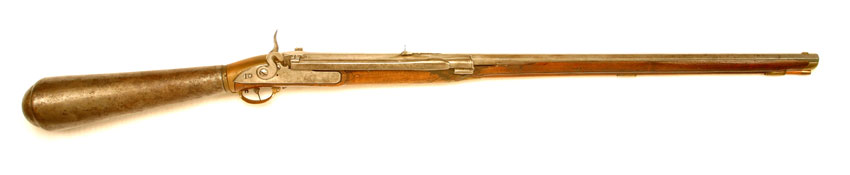
Figure 1. Girandoni military model repeating air rifle invented by Bartholomäus Girandoni, Vienna, Model of 1780. Full length view, right hand side. Breech loading, rapid fire repeater, issued with two extra air reservoirs and three extra 20 shot speed loading tubes. At first, a long hand pump was provided to every soldier, later to every other soldier. The magazine has always been described as holding 20 balls, but this specimen has a capacity, with one ball in the firing position, of 22 balls. Note that the air reservoir serves as the buttstock and does indeed look “bag shaped”, consistent with Rodney’s remark (Smith and Swick, 1997) about the ” air bag which forms the britch (breech) of the gun”. (The Girandoni photos of this chapter illustrate the "Beeman Girandoni" - from the Beeman Airgun Collection. All photos of Beeman collection by Robert Beeman; reproduction forbidden without written permission of Robert Beeman.) ©2002, Robert David Beeman
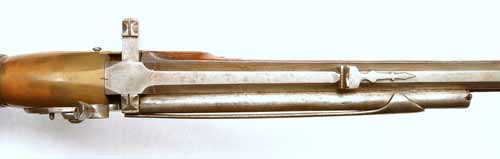
Fig 2. . Beeman Girandoni - showing tubular ball magazine on right side of gun, distinctive loading block traversing the receiver. Note that receiver casting is a single, seamless top piece. Beeman collection. ©2002, Robert David Beeman
Carrick accepted the Rodney report as revealing that Lewis probably carried a Girandoni-system airgun. At first there was a burst of acceptance of the Rodney report, but upon some reflection, I, and most airgun historians and experts, began to have severe doubts that this report could be correct. It would seem that Carrick, and others, made a huge, understandable, but rather elitist, assumption by pointing to Rodney’s character and position as supporting his credibility. The present author, and many others, felt that, looking at the credibility-related remarks repeatedly stated by Rodney’s editors, the records of the expedition, and especially considering what we then thought we knew about Girandoni airguns, and that no repeating airgun which bore evidence of being the Lewis airgun appeared to exist, Rodney’s credibility should be questioned and that this paragraph of his report could be spurious (Beeman, 2004).
The editors of Rodney’s journal warned readers that Rodney, despite being a judge and a noted politician, indeed on an appointment from Thomas Jefferson, had had a “bumpy career” including multiple accusations of corruption, bribery, and theft of funds which had led to prison time. Especially strong was the remark by his own editors: “Assuredly, both creative exaggeration and rich embellishment had their share in coloring his memory – it is impossible to sift fact from fancy in some of his descriptions”. While Smith and Swick seem enthralled with this most unusual man, a careful reading of their introduction reveals that the effusive, enthusiastic, mystic Thomas Rodney must have been an odd duck and a rascal with the morality of an unrepentant politician combined with a driven ability to prolifically write in a self-aggrandizing manner. This feeling is reinforced as one reads the entire book, but, as I noted in my previous papers, of those tales of Rodney which are now considered fanciful, most were directed at increasing his own significance in history.
Objections to a Girandoni as the Lewis and Clark Airgun:
The above description depicts a gun which should have been a real star item on a wilderness expedition. Outside of the obvious basic problem that no known specimen of airgun seemed to fit the Rodney account, what objections were raised to the proposal that the Lewis and Clark air rifle was a Girandoni-system airgun?
To condense the key objections, based on our previous knowledge of the Girandoni (Beeman, 2004):
Standing alone, the Rodney report was not fully compelling and contained large seeds of doubt. There seemed to be more reasons NOT to believe it than to accept it. Many Lewis and Clark and airgun history students remained supportive of the Lukens DNH .32" caliber air rifle as the Lewis airgun. It has now become clear that if Rodney's passage about the airgun has credibility, that rests, not on Rodney’s character or social position, but on three very special things: 1) The number 22. The Girandoni military air rifles basically were designed as 20-shot guns, with 20-shot speed loaders, etc. Certainly all accounts about the gun which could have reached Rodney would have given 20 as the shot count of the gun. Even today, all previous references gave 20 balls as the capacity of the gun. But 22 is the correct ball capacity of the Girandoni military air rifle. 2) The phrasing of his report. The ways that he describes leakage, firing failure, etc. are not the kinds of phrases that one would conjure up to inject impressive details into a contrived tale. 3) We now have an actual specimen of a repeating airgun which supports each previously suspect detail of the narratives.
The Turning Point:
The turning point in this study came as the accidental result of a most unlikely series of events. Ernest Cowan and Richard Keller, the highly respected, master museum-copy gun maker/historians who are known for their incredible, high-end museum-copies of the Ferguson multi-thread breech loading flintlock and other antique guns, became interested in making a set of just four precision, authentic museum-copies[14] of a Girandoni repeating air rifle. This desire stemmed from the fact that these two gentlemen were among those who were convinced by Carrick's conclusion that the Rodney paper was a legitimate report of Lewis' airgun as a Girandoni system arm. The Beeman paper (2004) gave strong evidence that such a conclusion was not yet justified at that time.
Their first step was to locate a Girandoni air rifle that they could use to precisely guide their work, but no such specimen was immediately evident in America. Cowan contacted the outstanding British gun illustration experts Geoffrey Baker and Colin Currie, who had just published a preliminary set of working diagrams of the Girandoni Austrian Military Air Rifle (Baker and Currie, 2002). They referred him to the Beeman Airgun Collection in California as having America's best collection of Girandoni and Girandoni-system airguns, including the only specimen known in America of the Girandoni military repeating air rifle. So Cowan called to ask if they could borrow our military Girandoni repeater and completely disassemble and study it. In early November 2003 we consented to such an exhaustive study of the "crown jewel" of our collection. This step triggered the following most unexpected and amazing series of events:
SIX AREAS OF NEW EVIDENCE ABOUT THE IDENTITY OF THE LEWIS AIRGUN
Evidence Area 1: The Replaced Mainspring
After many months of intense confidential study of the "Beeman Girandoni", Cowan and Keller concluded that this gun definitely is an authentic military version made in the Girandoni shop. Baker and Currie, studying Girandoni design and function in England, concurred with this conclusion. While studying details of the special flat mainspring, Cowan made a startling, most unexpected discovery: the mainspring is a replacement! And, our mainspring was not just a replacement, but a very old replacement that apparently had been made using a farrier’s file (a horse hoof trimming file - a type of coarse rasp also commonly used as a rough wood rasp) as spring material. A small area under the mainspring revealed the almost completely removed diamond shaped groove pattern of such a double cut file. Other astonishing discoveries about this gun were made in the Cowan shop before it went into high security storage at the U.S. Army War College in March 2005. (In March 2006 it was moved to a Lewis and Clark display at NRA's National Firearms Museum. In May 2007 it went to its final home at the Army War College in Carlisle, Pennsylvania - but that is getting ahead of our story.)
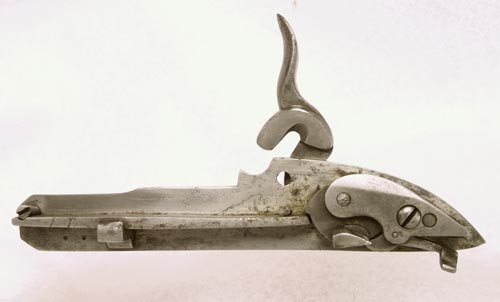
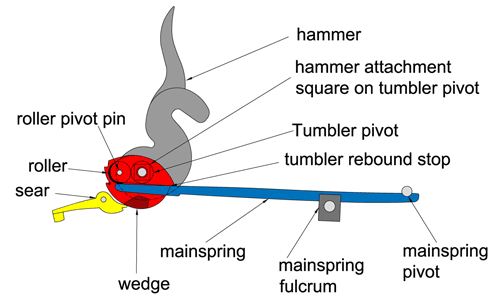
Figure 3. Inside view of the Beeman Girandoni military air rifle lock with hammer in the resting position. The heavy flat mainspring extends along the forward two thirds of the lock plate. This unusually strong mainspring allowed much greater stored air pressure than the traditional V shaped spring (thus allowing the potentially higher power of the Girandoni design.) Beeman collection. ©2002, Robert David Beeman
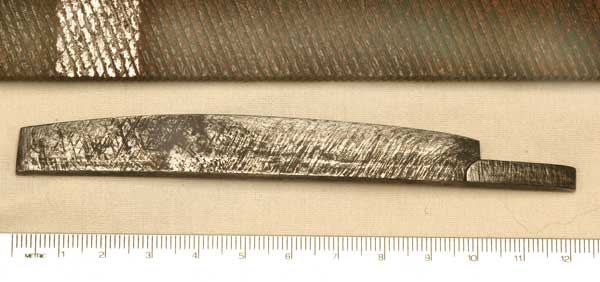
Fig. 4. Underside of the flat mainspring as removed from the Beeman Girandoni (“the study rifle”) by Ernie Cowan. Cowan noted that this replacement spring apparently was made from a farrier’s file as evidenced by the diamond pattern in the forward region. Above is a slightly different farrier’s file that has been ground down by Cowan to show the distinctive diamond shaped marks. Just a few more strokes of the spring maker’s file and these marks would have been gone, but a few more strokes and the spring might have been too thin. (Unless otherwise noted, scales in my images are marked in millimeters.) Beeman collection and photo. ©2005, Robert David Beeman
Lewis had recorded on June 9, 1805 (probably June 10, 1805) that the mainspring on his airgun was repaired[16].He wrote that "Shields renewed the main Spring of my air gun we have been much indebted to the ingenuity of this man on many occasions, without having served any regular apprenticeship to any trade, he makes his own tools principally and works extremely well in either wood or metal..." That Lewis's airgun had a replaced mainspring is one of the only solid bits of evidence that the expedition journals reveal about his airgun. Such a repair to this gun is of the very kind that would be expected of John Shields, the expedition’s well-experienced, much praised gunsmith/blacksmith[15]. A farrier's file probably would have been the only piece of suitable metal and size that would have been available to replace such a long, thick mainspring in a wilderness setting. It is possible that such a file would have been even better material for this purpose than the original, early type of steels used by Girandoni. Lewis made it clear, in the above note and elsewhere, that Shields was capable of such special work as shaping, annealing, and re-tempering the file metal. A farrier's file would be expected among the large amount of equipment and supplies carried by the expedition's gunsmith/blacksmiths. It would have been a basic item for rough repairs of the many heavy wood items as well as for caring for the horses that the expedition expected to obtain in the Rockies. We certainly would not expect a gunsmith in a civilized area to utilize such an odd source of material.
Many modern readers, especially Europeans, might not feel that a blacksmith would be suitable as a gunsmith. In Europe the frontier has been gone for centuries and the crafts became rigidly separated by guild rules. Some Europeans have a hard time thinking of blacksmiths, which in Europe generally were heavy-handed, rough workers, as doing gunsmith work. However, on the sparsely populated frontiers of early America it was common to combine the roles of blacksmith, gunsmith, farrier, and even handyman. The forge of an American blacksmith was ideal, not only for making wagon or boat parts and horseshoes, but also for annealing and tempering gun springs. Such workers could fix a rifle lock as well as hammer out a rudder strap or shoe a horse. Shields evidently was an especially skilled and talented example of such a craftsman.
A broken mainspring would not be expected in a Girandoni system gun with the correct flat mainspring[17]. The design and great ruggedness of this very special mainspring would be expected to avoid the breaks that almost are routine with the typical flintlock V-shaped mainsprings, with their back bend of extreme stress. In normal use, the likelihood of such a flat mainspring breaking within the closed gun should be close to nil. However, a secret Achilles heel of the big, flat Girandoni mainspring has been discovered. Careful examination of the inside view of our lockplate will reveal that the mainspring of the lock removed from our Girandoni has been restrained by a drift punch. Fortunately, I had the advantage of having read Baker and Currie’s first study of the Girandoni military air rifle before disassembling the gun. There the purpose of the mysterious little hole in the lock plate is revealed. Obviously a traditional spring clamp, designed to compress the V-shaped mainspring found in most flintlock firearms, cannot be used to restrain a flat mainspring. Placing a drift punch through this hole will allow disassembly, cleaning, and repair of the removed lock assembly without the sudden release and breakage of the flat mainspring! Unfortunately, the men of the Voyage of Discovery did not have such a manual and the mainspring easily could have been broken when taking the gun's lock apart for cleaning (or drying!). Or the original mainspring could have been made of some of the "faulty iron" that plagued Girandoni.
There is another possible cause of the mainspring breakage. Private Whitehouse recorded using the airgun to signal to a lost member of the party[18]. Martin Orro and Henry Elwood (personal communication, 15 August 2004) have shown that it is possible to fire a butt reservoir air rifle (a replica of the Lukens DNH), by snapping the external hammer/cocking lever several times in a minute, to create a distinctive and attention getting staccato. If such a practice had repeatedly been carried out it might have been injurious to the metal structure of the mainspring and possibly contributed to a failure.
The discovery of the replaced mainspring led to consideration of several other areas of evidence about this specimen:
Evidence Area 2: Number of Shots Per Air Charge
Wood and Thiessen (1985) [22] note that the narratives of Charles McKenzie, whose visit to the Hidatsa and Mandan Indians in 1804 overlapped that of Lewis and Clark. McKenzie, reported that “The Indians admired the air gun as it could discharge forty shots out of one load, but they dreaded the magic of the owners.” Of course, by "40 shots out of one load", it has always been clear to us that that meant 40 shots from one charge of air. This is how modern PCP shooters often refer to their shooting capacity, and even in the 19th century the single shot Giffard CO2 guns were promoted as "firing 300 shots from a single load". I formerly had felt that a Girandoni could not hold enough air to fire forty of those huge lead balls. But now, actually having fired 64+ balls on a single air charge, that no longer is a reservation. Even a smaller, a quite different, Staudenmayer butt reservoir gun gave one test run which showed a tank capacity of 39 shots. (Konwiarz, 1983). Butt reservoir guns typically can fire 35 to 50 shots per single air charge while ball reservoir guns generally can manage only 10 to 20 shots. A magazine size of 40 is unknown in any specimen. Such a tube length would be absurd; it would be clumsy and serve no particular function; loaded it would add great weight, and such a gravity fed magazine would cause ball deformation as the soft lead balls in a partially filled magazine slammed back and forth with considerable force in that very long tube as the gun's muzzle was pointed up and down. Significantly, no specimens of any Girandoni-system airguns are known with such a vastly extended magazine.
There could be several explanations of McKenzie's comment. Perhaps the most likely is the most casual - he saw it fired many, many times , an astonishing number of times, but not even to the end of a magazine load. Lewis probably never allowed that to happen - I would never have allowed the gun to run to empty in view of an Indian if I had been in Lewis' place. Stopping short of empty would give the impression, to those unfamiliar with repeaters, that "this gun can continue to fire forever!" And Lewis simply told McKenzie a basic fact about the gun - it can fire about 40 times - meaning 40 times on a single air charge. The shots beyond 20 would not be world beaters, but just firing them would have been impressive. Also, forty is exactly two speedloader loads, representing a quick and easy way to load the magazine. Lewis may have let someone, maybe just another expedition member, see him load the balls into the gun - he may well have fired a magazine load, and then a quick speedloader refill - to come to that amazing total. Original instructions to Austrian soldiers advised them to only fire one loader tube of 20 balls before switching to another fully charged air reservoir. (The partially used reservoir could be topped-off with the hand pump during a lull in battle. Evidently those hand pumps were intended only for such field topping-off operations.)
About the same time as we were considering the mainspring repair matter, the British experts Baker and Currie had been conducting test firings with a .51 caliber Girandoni replica. They got 35 shots before they got tired. If that gun had been made in the correct .46 caliber Girandoni, like this one, it would have provided an even higher shot count. So, the 40 shots per charge (load) point[19] (see Beeman, 2004) could no longer be used to rule out a Girandoni system air rifle. Now we were looking at this gun in a whole new light and even more surprises were forthcoming from this gun's examination..
The most recent tests, noted above, by the author using "G4", his Cowan-made exact museum copy of the Beeman Girandoni, revealed a most telling result: starting with an air charge of 800 psi, this gun fired 64 lead balls from a single charge of air! And even that last ball was significantly deformed when it struck a metal plate! It would seem that even that last ball could have been very harmful to a human skull!
Evidence Area 3: Damage to the Airgun
This Girandoni air rifle evidently was the victim of a major accident. On August 6, 1805, while ascending the Jefferson River, three of the canoes swamped while navigating rapids. At least one of them struck rocks and nearly crushed Private Whitehouse. There was considerable loss and much damage to equipment, which appears to have included the air rifle. In his journal entry for the next day, Captain Lewis wrote, "my air gun was out of order and her sights had been removed by some accedent I put her in order and regulated her. She shot again as well as she ever did." indicate not only that the airgun was among the damaged items but that the airgun had been in regular good use. Although the expedition airgun surely would have been wrapped in a manny cloth, or similar cover, it could have sustained severe damage by impact against stream rocks. Very close examination of the Beeman Girandoni reveals subtle signs of severe impact damage, to the center and left of the forward part of the gun, that is consistent with such an accident. Except for the front sight, the damage was not of the nature which would interfere with the practical use of the airgun. The forward barrel lug that bears a cross pin which retains the brass nose cap on the forward tip of the stock, has been torn open and later partially repaired. Sections of stock wood on each side of the loading slide have been broken out as would be expected from severe impact to the upper side of the gun. The forward end of the very thin, full-length forearm wood must have suffered extreme damage. It must have been subject to some makeshift field repair, perhaps just lashing, to hold it together. The original cast brass middle thimble evidently was crushed and an inconsistent rolled brass thimble, of American styling, substituted at the time of the field repair or later permanent repair. (The original cast part could not have been bent back into shape without breaking.) The existing wooden cleaning rod ( the “ramrod” in such an airgun is used only for cleaning and clearing the bore) clearly is a replacement; consistent with the center and left front area of the barrel and stock being severely impacted[20]. The forearm now shows an excellent repair in which the forward section of the forearm has been given a very old, but excellent, replacement. The replaced piece is expertly inletted to the contours of the underside of the barrel and very nicely joined to the original stock with a scarph joint. Scarph joints are very long angled joints used for millennia in shipbuilding to solve the problem of securely end joining long, thin pieces of wood. The scarph joint was adopted by 18th and 19th century gunsmiths to make secure end-to-end joints in the wood of long, very thin flintlock forearms[21]. Such joints virtually never were used by 20th century gunsmiths because they generally no longer had to deal with forearms with such incredibly thin wooden walls. Perhaps the most interesting feature of this old repair is that Cowan has identified the added piece as made from American walnut, with its diagnostic long fiber rays, while the original stock is the expected European walnut with its diagnostic short fiber flecks! It is possible that the final repair was made in the field by a skilled person. This would not rule out John Shields, or perhaps someone else, during the expedition, but more likely it was done after the expedition in a regular gunshop.
That the Lewis airgun was in the Lukens shop after the expedition may be the result of it having been returned to the only airgun maker in the Philadelphia area for repair. It may have been repaired there, probably by a local stock worker regularly used by Lukens, and remained as the property of the shop or it may have remained there because of the untimely death of Captain Lewis.
Obviously, an air pump accompanied the Lewis airgun on the expedition. However, if an air pump, and perhaps even an accessory pouch (see Austrian Airguns section of this website), had accompanied the Lewis airgun back to the Lukens gunshop after the expedition, it (they) almost certainly would have been separated there from the airgun, especially at the time of gathering goods for the Lukens's estate sale. These side items simply would have been among the many airgun accessories in the Lukens's shop and disposed of separately at the auction. Thus we would expect that the Lewis airgun would have been sold without a pump. The Beeman Girandoni was without a pump, pouch, or case.
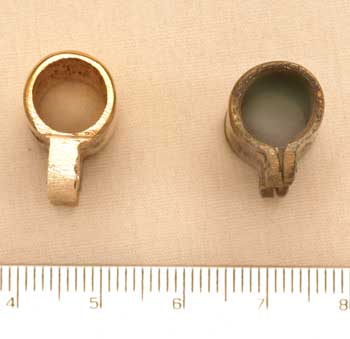
Fig. 5. Right: Replaced middle thimble (right) from the Beeman Girandoni, compared with an unfinished middle thimble of correct original style (left) from an unfinished museum copy of the Girandoni air rifle made by Ernie Cowan. Note that the replaced thimble is simply rolled flat brass plate while the original style thimble, like the other thimbles on the Beeman Girandoni specimen, is a solid cast brass part. Beeman collection and photo. ©2005, Robert David Beeman
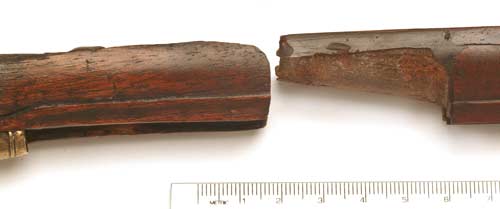
Fig. 6. Opened scarph joint in the forearm of the Beeman Girandoni. The wood at the left is original European walnut. The replacement wood at the right is American walnut. Beeman collection and photo. ©2005, Robert David Beeman
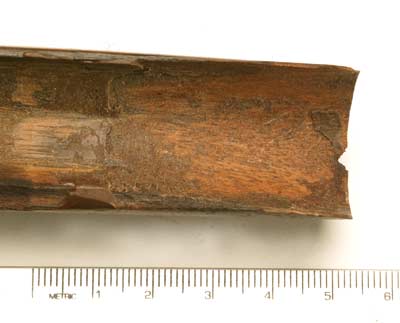
Fig. 7. Top view of female section of above scarph joint. Note the incredible thinness of the wood on the sides, actually tapering to less than paper thick.! Beeman collection and photo. ©2005, Robert David Beeman
It has been said that historical artifacts can sometimes speak to us through the ages. This gun tells us that not only does it have many special features and an old injury consistent with the recorded adventures of the Lewis and Clark expedition, but that, regardless of where it might have been in the meantime, it apparently was in America during the 19th century.
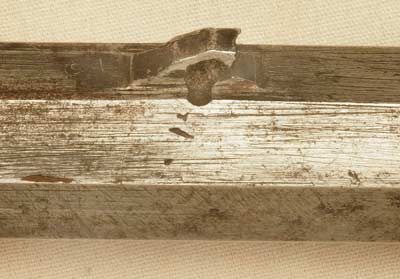
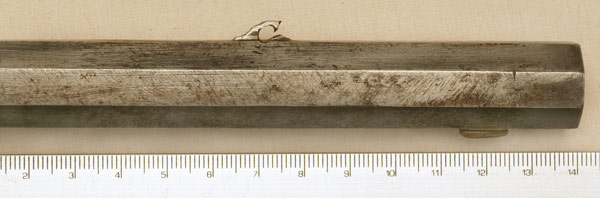
Figs. 8 and 9. Underside of the octagonal barrel showing the forward pin lug of the Beeman Girandoni air rifle. This lug had been torn open by great force. It is complete and evidently has been tapped back into a functioning position; too much tapping might have broken the lug off. ( Post-accident handling of the gun almost surely could not have been strong enough to cause such tear in the metal.) Note the consistent lengthwise marks of the original draw filing of the barrel on the bottom flats of the barrel (here shown on top). These flats evidently were not subject to the impact of the accident. The left barrel flat (shown in the bottom of the upper, magnified view and in the center of the lower view) reveals the overlaying marks of rough field filing as would have been made by a right handed person holding the gun, muzzle to the right, in a clamp or even on his knees. ©2005, Robert David Beeman
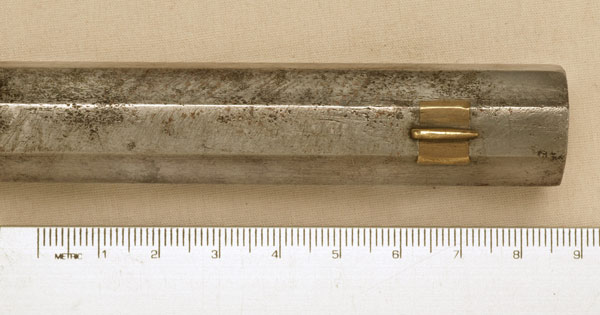
Fig. 10. Upper end of the barrel showing the irregular file marks made during field repairs of the impacted areas. Pits of the original impact injuries are still evident; running one’s fingertips along these apparently smooth flats reveals them to be bumpy and irregular. Only the upper and left areas were impacted. Original longitudinal draw marks, made during the manufacture of the gun, are still visible on the right hand barrel flat (and the flats on the bottom of the barrel). Note that the left hand end of the front sight was filed off flat during these improvised repairs. Beeman collection and photo. ©2005, Robert David Beeman
Turning to the barrel surface and sights, close examination reveals that the longitudinal draw file marks of the original barrel surface have been interrupted around the left side of the front sight and the left front flats of the octagonal barrel. This is dramatically evident when one runs their fingers across the metal of this area. The original draw file marks are crossed, or obliterated, by rough transverse file marks which indicate field trimming of impact gouges in the left forward area of the wrought iron barrel metal and replacement of the front sight. This is consistent with the note of Lewis that “her sights had been removed by some accedent. I put her in order and regulated her.” The rough nature and irregular angles of the forward filing marks strongly suggest that it was not a skilled metalworker such as the gunsmith/blacksmith Shields who did the work. He surely was too busy fixing other guns and important items that suffered more serious damage in the boat accidents. The file marks are exactly what would be expected from an unskilled worker seated and holding the gun across his knees. Perhaps it was Meriwether Lewis himself who wielded the file as part of his putting “her in order and regulated her.” The "regulation" would, of course, refer, at least in part, to adjusting the sights which he had returned to the gun. Most anyone familiar with open gun sights would have gently tapped down a side of the dovetail to secure the sight after adjustment and thus we would expect the sights to still be on the gun at the end of the trip - especially absent any note to the contrary. If he had made new sights, or had had Shields make them, surely there would have been some mention of that. Instead he just refers to putting things in order and simple regulating - as in securing broken parts of the stock, returning the sights, adjusting and securing the sights, and filing the gouged places in the metal.
The fact that the forward part of the barrel, barrel lug, cleaning rod, and thimble were injured would rule against the idea that the forearm simply was replaced due to age or drying cracks. Clearly this gun has been involved in a horrendous accident. The damages simply were not the kind of injuries that could be due to age, rough handling, or hunting or storage accidents. They are exactly consistent with the gun, covered and in company with several other items, being dashed into streambed rocks just the day before Lewis put the gun in order and adjusted a replaced sight. The temporary repairs speak of the kind that would be done in a wilderness setting.
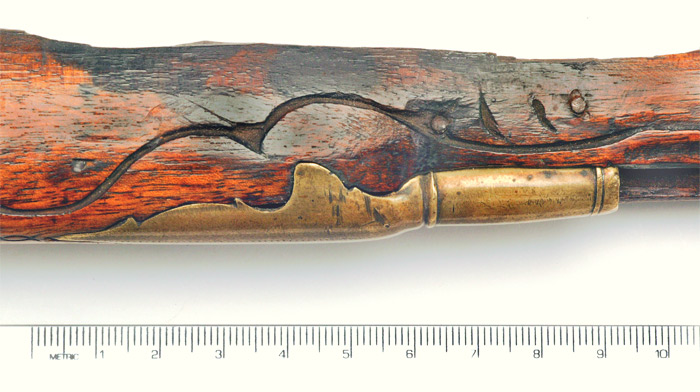
Fig 11. Right hand view of the mid-area of the forearm of the Beeman Girandoni. The dark, damaged areas are suspected of being charring caused by excessive heat from a campfire. The bruises, gouges, and the wood missing along the upper edge of this section of the stock also attest to brutal field handling of this gun. Beeman collection and photo. ©2005, Robert David Beeman
I have noticed some interesting charring of the original parts of the walnut forearm of the Beeman Girandoni. This charring is exactly the type of damage that I have observed when I was attempting to dry wooden objects near a campfire during my own extended stays in the rugged Selway/Bitterroot wilderness of Idaho. Remember that such unmarked specimens of the Girandoni military repeating air rifles apparently were guns which had been diverted from the Girandoni shops to "gentlemen" civilians. Thus such guns would not have exposed to the rigors of military field life - including campfires. The "gentlemen shooters" of that period returned home each evening from hunting - they would not have been huddled around campfires trying to dry out equipment. However, this gun, which we think was on a wilderness expedition of several years, could indeed have been subject to such drying by a campfire, especially if that gun had been submerged - an example would be the time that a great deal of equipment was soaked or lost when three Corps of Discovery expedition canoes struck rocks and were swamped in the Jefferson River on August 6, 1805.
Although the Beeman Girandoni air rifle obviously has been cleaned and polished many times through the centuries, close examination of the entire specimen reveals, not only the rough field file marks, the major stock repair, and the replacement of the ramrod and its thimble, as described above, but a very large number of impact dents, bruises, gouges, and scratches. The air reservoir/buttstock is severely battered. These marks and injuries are what would be expected of a gun that spent a long time as a hard used tool in rugged field situations. It is a testament to the design and production of the gun by B. Girandoni that it still is in fine firing condition (except for possible, not easily detected, age weakening or corrosion of the inside of the air reservoir. This alone would preclude any present firing tests.).
Evidence Area 4: Accidental Discharges and Malfunctions
Brunot Island Accident:
Captain Lewis' first journal entry of the
expedition recorded his stop at Brunot Island as he began his descent of the the Ohio River in the expedition's
keelboat:
Recorded on August 31, 1803 (shown as August 30):
"Left Pittsburgh this day at 11 ock with a party of 11 hands 7 of which are
soldiers, a pilot and three young men on trial they having proposed to go with
me throughout the voyage. Arrived at Bruno's
Island 3 miles below halted a few minutes. went
on shore and being invited on by some of the gentlemen present to try my airgun
which I had purchased brought it on shore charged it and fired myself seven
times fifty five yards with pretty good success; after which a Mr. Blaze Cenas
being unacquainted with the management of the gun suffered her to discharge
herself accedentaly the ball passed through the hat of a woman about 40 yards
distanc cuting her temple about the fourth of the diameter of the ball; shee
feel instantly and the blood gusing from her temple we were all in the greatest
consternation supposed she was dead by [but] in a minute she revived to our
enespressable satisfaction, and by examination we found the wound by no means
mortal or even dangerous;….”
How could this have happened and what does this experience tell us about the Lewis airgun?
There are several possible explanations how the accident happened. First, it must be remembered that Lewis had to dig the airgun out of items stored in his boat, virtually at the beginning of the expedition. He surely was not much more familiar with the gun than those to whom he was displaying it. The men present at this demonstration would have been quite familiar with flintlock firearms. It would be natural for Lewis, or any of them, to put the gun on half cock in an attempt to make it “safe”. The notch on the tumbler of a typical flintlock firearm is notched so that the sear is securely held in the half cock notch even if the trigger is pulled. With such a firearm, one must pull the hammer back enough to release it before the hammer can be lowered to the resting position.
If the gun, which Lewis presented to them, had been a single-shot muzzle-loader, the men of the group could have seen if a ball had been loaded and not fired. Not being familiar with repeaters and not having any way to tell if a Girandoni system airgun had a ball in the firing position, such a shooter might not have appreciated that such a gun was indeed loaded. Also, with a Girandoni, getting a ball in the firing position only would have taken someone easily pushing the intriguing breech block across[22] while the gun was being passed about, but that would still require the very intentional cocking of the gun and being subject to the defective half-sear. Obviously the airgun did have a ball in the firing position. The simplest explanation for the accidental discharge would be that the airgun was put on half cock and that Mr. Cenas, thinking that it was in a safe mode, was horribly surprised when it fired at an unexpected moment due to a fault of that half cock.
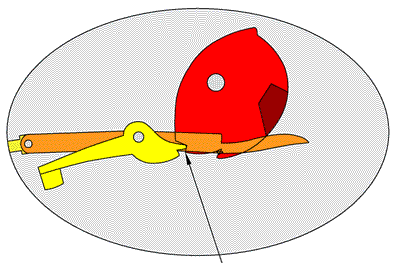
Cowan also discovered that the Beeman Girandoni has a faulty half-cock! The large majority of the spur on the half cock notch which should hold the mechanism against release, even with a strong pull on the trigger, is simply broken off. While the gun indeed can be brought to half-cock, it rests there in a very precarious manner. The firing action can be released by a very light touch to the trigger or even a jolt. If the half cock position was faulty and thus can release the hammer, it can gain some momentum before the wedge hits the striker latch notch and the valve will open discharging the ball. The shot will not be as powerful as from full cock but could be strong enough to be dangerous. Again, at this time, Captain Lewis probably would have been unaware of any functional problems of the gun and probably did not even realize what had caused the accident. There is no indication that any Lukens air rifle has such a problem.
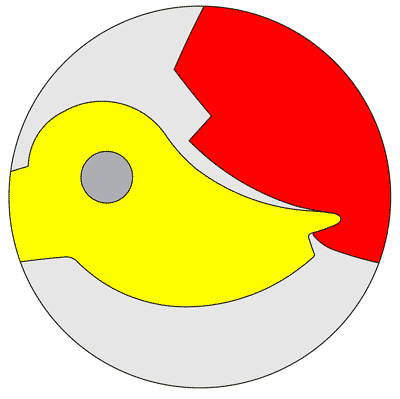
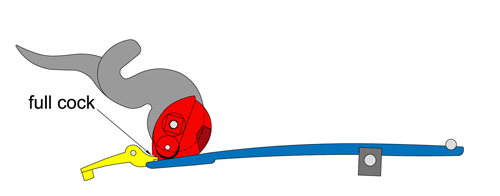
Fig. 12. Sear tip (yellow) locked into a properly shaped half-cock notch on the Girandoni tumbler (red). Note the full cock notch to the upper left. The sear tip locks into the full cock notch when the tumbler is rotated counter clockwise by cocking the hammer. Normal trigger pull then causes the sear to move down out of the open full-cock notch and release the tumbler to rotate rapidly clockwise and fire the gun. CAD diagram by Geoffrey Baker.
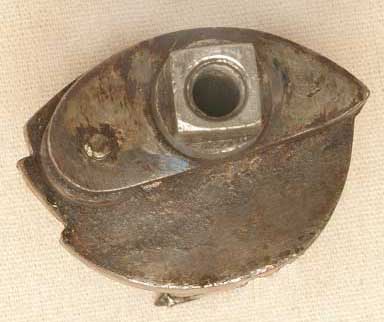
Fig. 13. Tumbler of the Beeman Girandoni. View from the gun’s right side. On the left are the full-cock notch (upper notch) and the half-cock notch (next lower notch). Note that the defective half-cock notch appears even more open than the full-cock notch. A very dangerous situation. Compare with the correct shaped half-cock notch in the colored figure above. (The working edge of the tumbler wedge just shows at the very bottom of the tumbler.) Beeman collection and photo. ©2005, Robert David Beeman
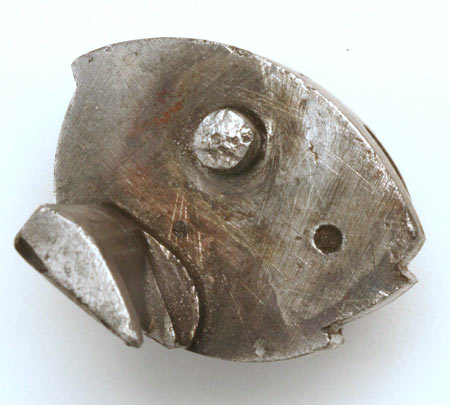
Fig. 14. Tumbler of the Beeman Girandoni flipped over to view it from the gun’s left side. At left is the tumbler wedge which, upon firing, transmits the energy of the mainspring which forces the tumbler to rotate counter-clockwise. The moving wedge pushes on the striker latch and causes the reservoir valve to release stored air. ©2005, Robert David Beeman
At right are the half-cock (left) and full-cock (right) notches. Clockwise rotation of the tumbler during cocking causes the sear tip to drop first into the half-cock notch and then into the full-cock notch. Note that about 1.5 mm of the half-cock notch lip is missing. Such an abnormally shallow notch, as found in this particular specimen, can only very precariously hold the tip of the sear. It cannot carry out this notch’s normal role of restraining the sear when the trigger is pulled. Thus this gun could fire most unexpectedly from the half-notch position. On the right is the full cock notch with its normal right-angle opening which allows a smooth, intentional trigger release and firing. Compare with the normal arrangement shown below. Beeman collection and photo.
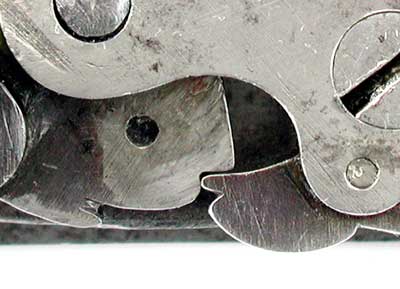
Fig. 15. Left hand view of the sear and tumbler of a normal Girandoni firing lock mechanism in an European specimen of a Girandoni military repeating air rifle. The sear is engaged with the full cock notch. Compare this normal pair of cock notches with those of the Beeman Girandoni in the figure above. Note that the full cock notch is similar, but somewhat more open, on this normal gun but that the half-cock notch is much deeper and would serve to restrain the sear’s tip if the trigger were pulled. Photo by Geoffrey Baker of Girandoni SN 1493 (the "Nolan/Fisher" Girandoni).
There are other less likely scenarios which could have led to such a potentially deadly situation. The studies by Baker and Currie give us (personal communication, 25 October 2004 and Baker and Currie, 2006), for the first time, a full understanding of how the Girandoni firing mechanism works. If Blaze Cenas pulled back the hammer to a point where the wedge engaged the notch of the striker latch and then engaged the hammer with the half cock or full cock, the sound and feel would be similar to the sensations on a conventional flintlock firearm. If he pulled back the hammer to release it from half or full cock, while holding the trigger to release the sear, and lowered the hammer, as he would be familiar with doing with firearms, this would have allowed the tumbler wedge to put mainspring pressure, via the striker assembly, on the air valve. With the very strong mainspring of a Girandoni the valve can be opened even at fairly high pressure allowing some air to escape. This fills the space between the valve and ball and reduces the pressure difference between that space and the air reservoir.
The escaping air leads to less force holding the valve closed and the force of the mainspring, applied via the wedge pushing on the notch of the striker latch, can further force open the valve in an extremely rapidly building cycle. A slight hiss of escaping air suddenly increases to a point where the valve is fully opened and enough air blasts out to propel the ball from the barrel. The velocity would not be as great as when the gun is fired from full cock but it could be dangerous. With the large reservoir of a Girandoni all of the stored air would not be lost.
Thus we now see that just because of the special way the complex tumbler is built in the military versions of the Girandoni repeating air rifle, coupled now with a tank of pressurized air, an accidental discharge of air is to be expected when the hammer is lowered from the full cock or half cock positions.
Experience with firearms would have taught the holder of the gun to point the muzzle to the earth or at least not at anyone. However, when the airgun started to make a strange hissing sound, the startled shooter probably would lift the muzzle – just before the gun completes the very rapid cycling and the ball is propelled out! Even though they were familiar with the peculiarities of airguns, Geoffrey Baker, when testing[23] their replica Girandoni in early 2004, caused his fellow worker, Colin Currie, to jump with fear when they accidentally experienced the “startling noise and shocking report” of such a situation! (Fortunately without a lead ball.)
Another possible scenario, related to the broken half-cock notch, would involve Mr. Cenas cocking the gun to the position of the second click. With a typical flintlock firearm, this would be the full-cock, firing position. Cenas then pulled on the trigger, but as the gun actually was in the half-cock position, nothing happened. In frustration he may have pulled very hard on the trigger and turned around a bit to demonstrate his problem to Lewis. As he did this, his excessive pull broke off the thin ledge of the half-cock notch and allowed the gun to discharge in the direction of the distant ladies. Any experienced shooting rangemaster has seen exactly this kind of dangerous gun swing executed by frustrated shooters.
Whether the defective half cock notch was caused or discovered at Brunot Island, this defect could well have been a key reason why Lewis did not allow others (except for very rare use by Clark) to use the airgun from this point forward.
The nature of the Brunot Island injury really tells us nothing about the gun which caused it. As discussed at length earlier (Beeman, 2004), even the perception of being injured can cause the kind of human reactions recorded. Note that Lewis states that he pumped up the airgun just before the firing demonstration. It is probable that he did not apply the thousands of pump strokes needed for a full charge at that time. Thus considering what effect a Girandoni system airgun could have had at highest power is irrelevant. If the discharge occurred due to improper lowering of the hammer on a Girandoni, such a discharge also would have been at reduced power.
Evidence Area 5: Firing and Function Problems.
The Airgun Demonstration to Judge Rodney. Wheeling, September 8, 1803.: Rodney recorded that Lewis lost all the air at the “first fire”. We know now that this could simply have been the result of very low air pressure in the air reservoir. When the air pressure gets so low that the air valve has very little pressure against it the valve stays open longer on each shot until finally the last air is released all at once, resulting in a very weak discharge. The air dumped on this first fire may have been residual air from the Brunot demonstration only a week earlier.
Having low pressure in the air bottle could have several effects. As noted, one is the accidental dumping of air which occurs when there is not enough pressure to resist the mainspring when the cocking lever is forward. Low pressure also could result in greater condensation and less wiping force on the striker pin. It was discovered in our specimen that the brass guide for the steel striker pin has an iron liner sleeve. Such condensation and lack of enough pressure to very forcefully push the striker pin could mean corrosion would develop on this steel pin and/or on the iron of the striker pin sleeve and cause the pin to stick in the open position[24]. Some condensation corrosion here would have been expected as a result of the shooting demonstration at Brunot Island the week before. Thus the enigmatic failures are now perfectly explained.
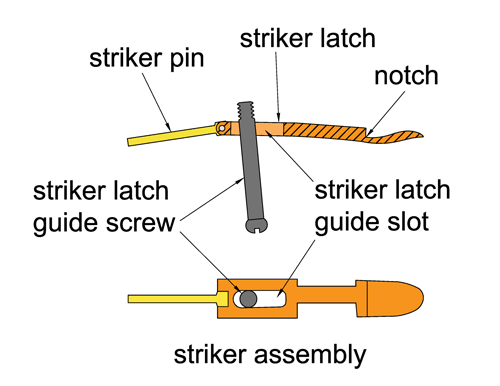
Lewis probably learned at Brunot Island and later that by just working the cocking lever several times, while the trigger is held down on an empty tank, that he could restore operation of the gun. While he may not have realized, at least at first, that this could result from freeing a stuck striker pin; he may have discovered this detail later. It also is easy to remove the lock plate, loosen the striker latch guide screw behind the trigger, and thus slip out the striker assembly for easy and rapid cleaning. Either of these simple acts of freeing a corroded striker assembly could be the simple, quick adjustment that Rodney referred to at Wheeling. Also, although the striker latch guide screw has no adjustment role, it sometimes becomes loose. When Lewis had the problem, he may have noticed that this screw was loose, tightened it and then when the airgun was pumped again, the new pressure in the reservoir would assist the closing of the valve and allow shooting to continue in a normal manner. This would also have been true if he had done the meaningful cleaning or working of the striker pin.
Ironically, Lewis may have inadvertently often kept his airgun in an undependable condition, due to condensation corrosion. Soldiers, who had to depend on the air rifles for their lives, might have had this problem much less often because they used their guns more often and they were trained to keep these pins polished and lubricated.
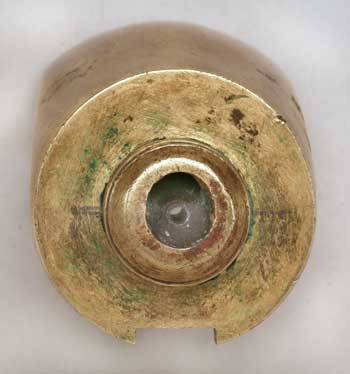
Fig. 18. Rear surface of the receiver of the Beeman Girandoni. The little steel striker pin tube in the dead center of the receiver may have been the cause of sticking valves, esp. at low air pressure. The striker pin must be fitted very closely into the striker pin tube as this is one of only four points where air could leak. Air pressure is present here only during the milliseconds of discharge and leakage is prevented only by friction and lubricant. The slightest bit of rust or stickiness between the closely fitted iron striker pin and this steel striker pin guide could prevent, or retard, movement of the striker pin and thus prevent firing or it could cause air dumping. The bean-shaped black area above the striker pin tube is the entrance to the air passage which was drilled and filed into the solid metal casting when the gun was made. The valve body of the air reservoir screws onto the threaded shaft presented here, separated by the cow horn gasket mentioned in an earlier caption. Beeman collection and photo. ©2005, Robert David Beeman
The important point here is that it has now been shown that it is easily possible for a Girandoni system airgun to have had exactly the kinds of air release problems and field adjustments described for the Wheeling airgun demonstration. This removes another very important question about the credibility of the Rodney account. And it is significant that these actions occurred, and were recorded, eight months before the beginning of the wilderness section of the trip. By the time the expedition began in earnest Lewis and several expedition members could have become quite familiar with the airgun and would have begun to take its operations, actions and features for granted – matters not in themselves appropriate for comment in the journals.
Bud Clark, the great-great-great grandson of Captain William Clark, inadvertently provided (personal communication, 15 August 2004) a very realistic insight into the possibility that Lewis sometimes used the airgun at improperly low pressure. While Bud was acting the role of Captain Clark, in the 2003-2005 real life re-enactment of the original expedition, he was anxious to know (via email and satellite phone from the trail!) if I could provide him with a replica of the Lewis and Clark airgun so that he could demonstrate it, very much as Lewis actually did, at various public displays. He pointed out that he didn’t need a gun which would pass a full high pressure test as he would just be “charging it only enough to demonstrate its function”.
Evidence Area 6: Markings on the Beeman Girandoni
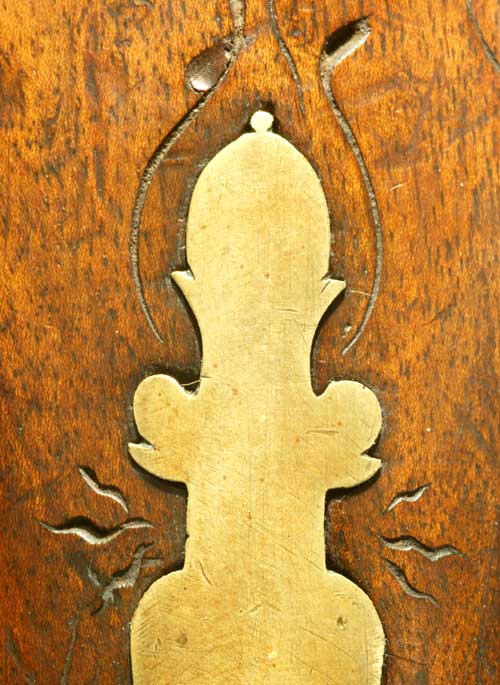
Fig. 19. Underside of the forearm of the Beeman Girandoni, showing the carved "lightning bolt" lines which may have been added during the Lewis & Clark expedition. Cowan reports that Indian experts indicate that such marks very likely were made to increase the “powerful magic” effect of the airgun to the Indians. ©2005, Robert David Beeman
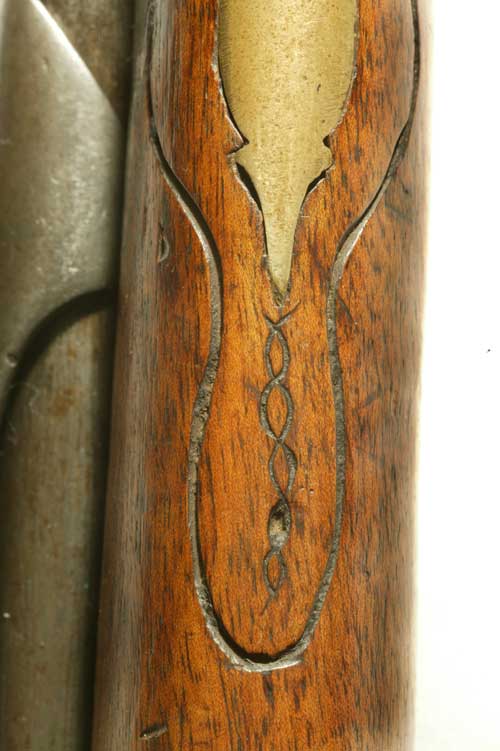
Fig. 20. Middle underside of forearm of Beeman Girandoni, showing "string of beads" carving of unknown significance. The "lightning bolt" and "string of bead" lines shown in the above two figures are not found on other known specimens of the Girandoni military repeating air rifles. Note, especially in places like the bottom of the carved loop and the defect in the "string of beads" shown in Fig. 19 above, and the tiny gouge marks around the lower left lightning bolt in Fig. 19, that these extra decoration marks clearly were not made by a master gunstock worker with fine stock carving tools, but rather they are the nature of carving that one would expect from someone very good with a very sharp, ordinary field knife - as on a wilderness expedition.
Even these special carvings have been very carefully copied by Ernie Cowan onto the four museum copies of the Beeman Girandoni. Beeman photos and collection. ©2005, Robert David Beeman
As shown above, the Beeman Girandoni has some unusual carved lines on the underside of the stock’s forearm, between the trigger guard and the first thimble. Nothing like them appears on any other known Girandoni system air rifle. Ernie Cowan and Rick Keller, in consultation with museum experts on Indian marks, indicate that these probably represent lightning bolts and may have been carved there, during idle expedition time, to increase the perception of “powerful magic” for the airgun.
I consider these "lightning bolt" markings as even stronger support for ownership of this gun by Captain Lewis than if we had found a gun with his name carved on it. A gentleman might have his name carefully inscribed on the side of a gun's lockplate by a skilled engraver, but gentlemen did not carve their names into gun stock wood! However, given the periods of boredom inherent in the stalled periods of such an expedition, adding some discreet symbols of such significance would seem very understandable. Close examination of these marks reveals that they were made by a very sharp knife and that they are very old, surely made in the same period as the gun itself. They certainly are not the kind of decoration, and do not represent the kind of skill, that would have been contributed by a professional stockmaker. With his attention to detail and concern for combat readiness, Lewis probably kept his knife very sharp. These marks very likely reflect some camp bound attention to the airgun by Lewis himself.
(I can well relate to such unnecessary detail work during periods when one is bound to a location in the wilderness. As a coincidence, I was snowbound for considerable periods, while researching elk migration during the 1950s, on trails very close to those of the Corps of Discovery in Idaho's Lochsa/Selway Bitterroot Wilderness Area. I spent many hours with my own sharp knife, making such superfluous things as a tiny, intricate, buckskin pouch for my Hastings triplet hand lens.)
In the area of markings, we also should consider what is NOT marked on the airgun. Although the airgun was mentioned in the journals more than any other arm on the expedition, obviously the center of a lot of attention, no mention was ever made of the mark of that famous maker. The journals reveal that Clark had a personal flintlock rifle, of much lower interest, referred to as the Small rifle (made by John Small), but there was no mention of the airgun's maker. Throughout the history of guns, their users commonly have referred to their weapons by the name of the maker: "my Colt, Winchester, Purdey, Garand, Springfield, Mauser, Luger, Sharps, Thompson, Gatling gun", etc. etc..
This is strong evidence that Lewis' airgun was one of the small number of military rifles (reportedly up to 200 guns, but probably a far lower actual number) known to have been slipped to private buyers by Girandoni before his death in 1799. These guns certainly would have been without any maker's mark or serial number and almost surely would have been plain and unornamented. That would eliminate all "surplus" or "lost", Girandoni-marked military air rifles and would narrow the field of candidates to only a few unmarked military specimens, made in the proper time window, most of which would fail or be lost, and virtually all of which would never reach America. I certainly concur with the strong opinion of Dean Fletcher, a student of American 20th century airguns, (personal communication, Lewis Reinhold, 23 Dec, 2005) that Lewis' airgun probably was an unmarked specimen of the Girandoni repeating airgun system. Our specimen is most unusual in being a true military model, plain and unadorned, of the appropriate sub-style/timing, without that famous maker's "G" and four digit serial number - just as we would expect of Lewis' airgun. It apparently is one of only two known unmarked Girandoni military model repeating air rifles.
Reference to the Airgun in the Expedition Journals
A firearm-based bias has produced a huge barrier to understanding the matter of the Lewis airgun. Firearms generally operate at full power but a pneumatic airgun can operate within a great range of power. Our understandings of what was recorded, and our expectations of what should have been recorded, in the expedition journals may have been deeply colored by the concept of an airgun operating only at high power. This bias especially is true of much of the modern consideration of the Girandoni airgun which has centered on, and assumed, operation at its potentially high power. The lack of experience by Captain Lewis with any airgun, coupled with a probable lack of information, would have been a tremendous factor in not using his airgun to its potential. Larry Hannusch, while now supporting the idea of a Girandoni for Lewis (personal communication, 17 November 2004), has reflected that our new considerations that Lewis probably was unfamiliar with airguns, and that the airgun sometimes may have been operated at less than potential power, got him to thinking in new directions, including appreciating that there is a HUGE difference between an airgun’s potential firepower and its practical firepower.
We know that Captain Lewis had real problems with the operation of his airgun; probably even more problems than were recorded in the journals or by visitor Rodney. Just the problems of operation and hazardous use at Brunot Island and Wheeling, before the wilderness phase of the expedition even began, may have been the keys to why we don’t read about the features, great firepower and wonderful action of the Girandoni airgun. With just those bad experiences in mind, would you bet your life, or even the critical success of hunting, on a gun that had so performed? One would expect that Lewis would have made the decision, after the problems of those first two shooting shows, even before leaving St. Louis, that the main value of the airgun would be for demonstrations to impress the natives. Let those potentially dangerous viewers admire this strange gun and “dread the magic of the owners” while he, and the other members of the expedition, may have been quietly unimpressed with it. They may have considered it only as a rather undependable “new fangled gadget”, rather than as a wonderful tool over which to wax eloquent! So, it proceeded on, perhaps only working after Lewis would clean and loosen up the striker rod and valve spindle and pump it, out of view, only as needed to produce a good show
Along the same line, there is a possibility that Captain Lewis, and the expedition party, may not have taken the airgun seriously. Therefore they would not have been motivated to regularly contribute the large amount of hand pumping necessary to bring it to its full potential. (Even modern users of old air canes find it exhausting to apply even the roughly 300 strokes necessary to charge their small reservoirs). This would explain many things, from continued poor performance, to lack of comment, and to a lack of serious consideration of the airgun for hunting or defense[25]. This gun, which had the potential to be such a deadly, high-firepower “assault rifle” (Gaylord, 1997) may not have been given a fair chance and/or it may not have been suited to solitary use on a wilderness expedition without proper training, the presence of experienced airgun personnel, and a wheeled air pump and/or a running supply of pre-charged bottles. (We should note here that while a Girandoni could be compared to an "assault rifle" in comparison to the muzzle-loading black powder firearms around the beginning of the nineteenth century, it truly would be absurd to so consider such a gun two centuries later in our present period of rapid fire and full automatic firearms!)
I think that it is very probable that the early problems with the airgun served to teach Lewis how to use and maintain it. Ernie Cowan and Richard Keller (personal communication, 3 November 2004) feel that the airgun was fully appreciated and that pumping it up to high power, to maximize the impression of the demonstrations, would not have been that unlikely, especially if one considers the spare time that may have been available at times and that one could use the services of a slave and line soldiers. The expedition crew would just have taken it for granted after first learning of its features, operation, potentials, and shortcomings. The leaders and scribes of this journey commented very little on the details of other expedition items. Their charge was to record the findings of the trip, so it would be understandable if they did not do more than note some of the events involving the airgun. And, there are major time gaps in the journals.
As for hunting, it is possible that the airgun was not always up to top power, and even if it was, it would still have been less powerful than trusted and familiar firearms. Hunting was not a matter of sport for these men. While a serious wound , even a wound resulting from a shot from a partially empty air reservoir, would take an enemy soldier out of battle, only quickly lethal wounds were appropriate to hunting. Lewis apparently did not do much hunting and, wisely fearing it misfiring due to its hazardous condition, plus wear and breakage, it is probable that he would not have allowed the airgun to leave his side. It was just too hazardous for regular handling by others and it had just too much possible vital strategic importance to be subject to breakage during frequent use or to be exposed to too much familiarity by the natives. Only his trusted and bright partner, “Captain” Clark, was ever also allowed to fire it.
"The Key to the
American West" or
"The Most Important Individual Gun in American History"
The title above is meant only to parallel the title "The Gun That Won the West" - The Lewis airgun certainly didn’t “win” the West – that was done over many years with strategy and by great intimidation and violence from Colt and Winchester firearms. It is interesting to note that the significance of those firearms also came from being repeaters - but more than a half century after the Girandoni repeating air rifles! And it didn’t ”open” the West – much of the West had already been opened for trade with the natives by British traders. However, that truly was minor compared to what was accomplished by this expedition. This airgun is all the more remarkable in that it apparently developed its "firepower diplomacy" without having killed a single person.
It certainly can
be said that the airgun shooting demonstrations on the expedition were an enormous success. The
airgun created great respect for these travelers. For one example:
Private Whitehouse noted in his
expedition journal entry of August 30, 1804, when Captain Lewis demonstrated his
airgun to the Yankton Sioux in the Calumet Bluff area along the Missouri River,
apparently on the Nebraska side:
"Captain Lewis took his Air Gun and shot her off, and by the Interpreter told
them there was medicine in her, and that she could do very great execution. They
all stood amazed at the curiosity; Captain Lewis discharged the Air Gun several
times, and the Indians ran hastily to see the holes that the Balls had made
which was discharged from it. at finding the balls had entered the Tree, they
shouted a loud at the sight and the Execution that was done suprized them
exceedingly." The Indians would not have been able to comprehend the
gun shooting again and again and again without reloading - and without flash or
smoke.. This would have been terrifying considering the "execution" that
such a flashless, quiet gun had demonstrated as its potential!.
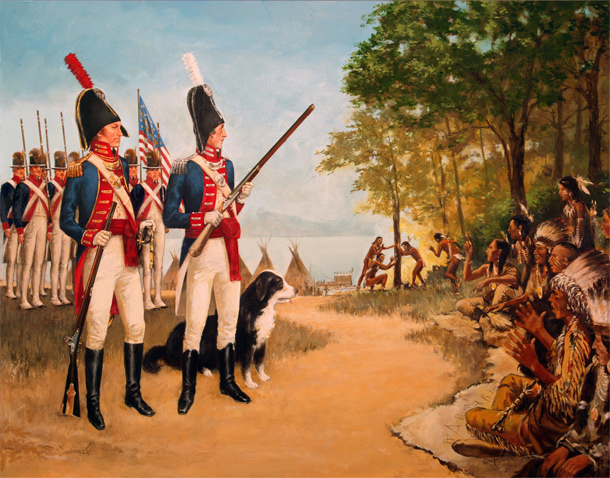
©2005, Robert David Beeman. Painting by
Warren Lee.
Air Power Diplomacy -Captain Lewis' "Assault Rifle"- The Key to the American West. Evidently Captains Lewis and Clark realized rather early in the expedition what a great impression could be made by dramatic demonstrations of the amazing properties and astonishing firepower of their "magic" airgun . Appearing in formal formation, flags and banners flying, dressed in their colorful full dress military uniforms with towering tasseled chapeaus, fancy coat tails, brilliant sashes, bright braid, and shining medals, the Corps built a tone of high theatre around the previously loaded and charged repeating air rifle. This painting illustrates one of these shows, as described by Private Whitehouse in his expedition journal entry of August 30, 1804, in which Captain Lewis demonstrated his airgun to a large group of high ranking Yankton Sioux in the Calumet Bluff area along the Missouri River. Some of the honor guard braves have run to the distant target tree and are incredulously reporting that numerous lead balls are buried in the wood even though the gun had not presented any smoke or fire and relatively little sound. Captain Clark, in later journal entries, made it clear that they implied that the Corps had a large number of these guns. (See notes about this painting and how to obtain copies at the end of this paper.)
It is apparent that many
Indians, if they had seen such an “assault rifle” in action, would have been
anxious to get aboard the expedition boats to see if the group had a supply of
these amazing guns. Captain Lewis always was careful to keep them from fully looking
around on the boats. If the trip leaders were flaunting a rapid fire Girandoni,
especially if they were careful never to let the natives see the gun run out of
balls, then “dread of the owners” of guns which apparently could fire an
infinite number of times with incredible speed, probably was a major
strategic factor in this little group of explorers never being attacked during
the long duration of the trip.[26]
If any Indian tribe had taken the expedition's weapons they
would have become the most powerful tribe in the regions. That the mere presence
of the airgun could restrain hostile action was demonstrated by Captain Clark's
note of September 25,
1804 concerning the Teton Sioux after he had noted that they feared that these
Indians were detaining them in order to rob them or worse: "Capt. Lewis
shewed them the air gun. Then we told them that we had a great
ways to goe &that we did not want to be detained any longer".
Surely
this meant that the airgun should be considered as a strong reason why they
should not be further detained. Clark's thinking was again revealed by his writing on April 3, 1806,
on their return journey when they were dealing with troublesome tribes on
the Columbia: "Lewis
fired the Air gun which astonished them in Such a manner that they were orderly
and kept a proper distance during the time they Continued with him...".
Clark clearly is saying that the airgun was the only thing that kept the Indians
at a safe distance. The Indian method of attack was to rush their enemy after
the defenders fired their single-shot guns.
These records
are some of the strongest evidences that the airgun was a Girandoni system
repeater; it seems almost impossible that a single-shot air rifle of relatively
small caliber would have had such
intimidation value.
The above passages may be some of the most least appreciated, but most important, notes in all of the expedition journals. Captain Clark, and undoubtedly Captain Lewis as well, clearly realized the potential of the airgun, backed up by an assumed further inventory of them, as a tool of "firepower diplomacy". The presentation of the airgun by Captains Lewis and Clark certainly was not a casual matter, but rather a calculated, considered strategy that apparently paid enormous dividends.
This is the first presentation of the idea that the expedition's airgun, as an "assault weapon", backed up by an inferred stock of more of them (or even perhaps the implication that all of their long arms could fire indefinitely without reloading), may well have been basic to the success of this important expedition. Lest we think that this idea might not have been inherent in the thinking of the expedition's leaders, we need only consider Captain Clark's remarks above and the previously unappreciated insight to Clark's thinking revealed during a frightening and complex confrontation with Chief Black Buffalo, commanding hundreds of aggressive Teton Sioux, on Sept.25, 1804, near the very start of the trip. Angered by threats, Clark recalled that "I felt My Self warm& Spoke in verry positive terms". Sergeant Gass recorded that Clark's "verry positive terms" included that "he had more medicine on board his boat than would kill twenty such nations in one day". For the very first time, we finally have an understanding as to what "secret weapon(s)" Clark was alluding. The implication apparently was that they had a large supply of these wonder guns right there on his boat. And, as noted, Captain Lewis, only three weeks earlier, had warned other Sioux viewing an airgun demonstration that "there was medicine in her, and that she could do very great execution". "Medicine", of course, was an Indian term referring to great, generally inexplicable, force - the kind of force which could be presented by many smokeless, fireless guns which could fire lethal, highly accurate balls with incredible rapidity, apparently an infinite number of times, without loading - yes, with enough "medicine" to kill, execute, twenty nations of Indians in one day!
An astute reader might consider the idea of such a strategy of intimation as simplistic and even racist. On the contrary, the Indians were the evolutionary result of a game of survival that went to their very beginnings and certainly was more current than it was for the white explorers. Survival selection especially favors intelligence and caution. If the Indians had looked at the explorers as they would consider another group of Indians, then some might well have attacked at some points and “filled ‘em full of arrows”. But they had the measure of other Indians. While they certainly were far from dumb, most were quite naïve about what powers these mysterious and astonishing strangers might have. The pomp and circumstance of the Corps of Discovery displays, with impressive dress uniforms and perhaps complete with bugling and flags, were calculated to enhance the impression of power and mystery. To gain some perspective, consider: If one were to meet a rattlesnake in the field, having never seen or known of one before, caution would be first reaction of an intelligent person. In the face of such threatening action and intimidating sound, it would be very natural to wonder how far, how fast, and how such an opponent could attack. When we first moved onto our ranch in the Western U.S.A., even though I was well aware of rattlers, I was extremely cautious in dealing with these very intimidating smaller fellows. Since then, I have killed scores[27] of them with relative ease – I now have the measure of them, knowing that just having a stick or other object reasonably more than two-thirds the length of the snake gives me the edge. Lewis and Clark probably could not have repeated their bluff if they had made a second trip! That most of the Indian tribes were naturally friendly and helpful does not detract from the fact that if only one hostile group had “filled ‘em full of arrows”, then American history might have been quite different.
We need to have a renewed perspective of the expedition itself. Chris Semancik, Arms and Ordnance Curator at the U.S. Army War College, (personal communication, 13 May 2005) and Jay Rasmussen, leading Lewis and Clark scholar, (personal communication, 22 May 2005) stress that the Voyage of Discovery, under the command of Captains Lewis and Clark, a full-scale military expedition, was THE event that first made the West tangible to and approachable by real people – rather than a meaningless void that had no particular value or possibility. Perhaps this was only a spark of information about potential wealth beyond imagination (wealth then being mainly fertile land, waterways, and resources) but it had a tremendous significance just as only a few seconds in the air by the Wright brothers sparked the studies which made flight tangible and attainable. Even if this perception, this spark, without the details to be provided much later by the journals, was felt only by a few, especially some leaders and those looking for a new horizon, it was of staggering long-range significance. That spark made the West, formerly a dim concept – even in Jefferson’s mind (and he was way ahead of the contemporary American public’s mental curve), real as a place of great riches and resources – a place that actually could be reached. The "Western Movement" and the nation's eventual claim to most of the Western states were the direct outgrowth of this shift in perception. These indirect results of the expedition were fantastically more important than all of the plant and animal samples, notes on the natives, mapping, etc. This expedition ranks as one of the very most significant events and turning points in American, even world, history. If this expedition had not successfully occurred, just when it did – the United States of America might not now have the incredible wealth and power which was added to the new nation by the development of the tremendous, but little known, areas of the Louisiana Purchase, the addition of the Western states, the control of our western areas and coast, and even the completion of Columbus' dream of a Western access to the Orient. Lewis' airgun may have had a pivotal role in this matter and could justly be called the "The Key to the American West". Officials at the National Rifle Association and the U.S. Army War College have indicated that they feel that Lewis' airgun was the most important individual gun in American history.
Colin Calloway (2003) closes his amazing book on the Native American West before Lewis and Clark with the perspective that "Lewis and Clark reshaped time......by their feat they created a new calendar: American history in the West unfolded after Lewis and Clark; anything that happened before was B.L.C. (before Lewis and Clark)." Although he could not have then known what impact the Lewis airgun had had on America's westward expansion, Jefferson understood how important guns could be in the shaping of American history. In 1806, he told Indian delegates to Washington that the new U.S. nation had peaceful intentions but that "we are strong, we are as numerous as the stars in the heaven, and we are all gun-men"! Lewis and Clark didn't enter a static world ripe for exploitation. Calloway notes that when Lewis and Clark started westward from St. Louis that "many of the people who had previously inhabited the West were gone." Some had died only a year or two before when the second big smallpox epidemic of U.S. history swept away many - even whole tribes. It has become politically incorrect to also note that several strong Indian tribes, such as the Apaches, Comanches, Osages, and Quechan league had not only stalled Spanish colonial advances but recently had decimated, absorbed, even obliterated, scores of Indian tribes. Some Indians remained where they had lived for thousands of years, while "it was the Spanish, French, and English, who had competed for their trade, their lands, their allegiance, or their souls, who had come and gone". As I have noted above, the Lewis airgun may well been a key to allowing the Lewis and Clark expedition, succeeding at this amazing moment, to spark the American occupation of the West, which as Calloway observes "occurred in the blink of an eye, historically speaking".
Miller (2007) makes a strong case that the Lewis and Clark expedition was basic to the concept of "Manifest Destiny" - the expansion of the United States to the West - a concept with a germination well before Thomas Jefferson - although it did not receive that name until the mid-1800s. As noted later, the Lewis and Clark expedition occurred at an unique window of opportunity. Present United States geography might have been quite different if the Lewis and Clark expedition had not returned - just when it did.
Auction Description of the Lewis Airgun
The Pennsylvania Inquirer and National Gazette for January 4, 1847 describes the airgun in the Lukens estate auction thusly: "Superior Air Rifle-- Made for and used by Messers Lewis and Clark, in their exploring expedition--1 superior air rifle of curious construction, shoots 25 times without reloading”. Again, “without reloading” may have meant without recharging or it could have been just a rough estimate of the gun’s ball capacity. The auctioneer referred to the famous Lukens estate Item 95 as “a great curiosity” – but this could refer to it being an airgun and/or having been on the Lewis and Clark expedition. “Curious construction”, on the other hand, can only refer to design that the writer thought was strange – and a single shot, muzzle-loading air rifle of generally familiar appearance probably would not impress one as having curious construction – a Girandoni repeater would.
The auction flyer’s reference to “large” for item 95 probably reflected the contemporary custom of using that word to refer to bore size, not total gun size. So considered, a.32 caliber rifle would not be a large airgun.
There was no indication that the gun of item No. 95 was marked Lukens. We have no further direct information as this gun was removed from public auction and disappeared from record at this point. The auctioneer had to have seen a tag saying, or have been told, that item 95 in the estate auction was Captain Lewis’ airgun. The auction notice stated that the airgun had been made for the expedition. We now know that there simply wasn’t time for custom building the airgun for Lewis, but the auctioneer probably assumed that simply because the airgun, associated with the Lewis and Clark expedition, was in the Lukens shop. Mentioning the Lewis and Clark trip would not have been a contrived advertising point for this gun. It is far too much to conceive that any auctioneer, surely unfamiliar, as was almost everyone during the entire 19th century, with the fact that any airgun had even been on that distant trip 41 years earlier, would fabricate a connection to the Lewis and Clark expedition for this particular gun at that particular time. The public enthrallment with the expedition and comprehension of its significance had to wait until late in the 20th century.
If indeed any of the accessories for the Lewis airgun came back to the Lukens shop they would not have been cased with the gun. The forty one years that passed before the estate auction would be expected to further separate them from the gun. Even if such accessories were somewhere in the shop when materials were gathered for the 1847 estate auction, it would have been unlikely that the auction staff would have recognized them as related to the airgun. And, even if they made it into the sale, such items probably would have been lumped with miscellaneous odd items and sold in separate lots or even discarded.
Where Did Lewis Get His Air Rifle?
Girandoni-system repeating air rifles were rare in Europe and virtually unknown in America around 1803; a situation which prevailed until very recently.. However, Captain Lewis hardly could have avoided the opportunity (Beeman, 2004) to obtain an air rifle from the Lukens shop in the one month time/space window (9 May 1803 to 9 June 1803) of his expedition supply gathering. As discussed at www.Beemans.net, it now seems clear that two men in the Philadelphia area, in their early twenties, namely Isaiah Lukens and Coleman Sellers, and perhaps Joseph Kunz, of similar age, became very interested in airguns[11]. They may have been America’s first “airgun nuts” and must have had at least a small collection of airguns, including at least one external lock air rifle from whose design they did indeed develop a simple, but wonderful, series of special air rifles. While it is possible that Lewis obtained his airgun from someone else in the area, the airgun enthusiasts at the Lukens shop would be the most likely ones, in that time and place, to have acquired a Girandoni air rifle. Airguns evidently were not known from any other American shop, then or before. If an interesting airgun had found its way into any place around Philadelphia it very likely would have been referred to the airgun group at Lukens shop. Likely scenarios could include such situations as a ship captain trading it for Lukens instruments or clocks. Meriwether Lewis may have purchased it during his inevitable association there with Isaiah Lukens (Beeman, 2004). The fact that Lewis’ airgun came to the Lukens shop after the expedition also tends to support the idea of that shop being the source of the gun. According to Wolff (1958) and the exhaustive listings of the Støckel (1978), there simply weren’t any other gunshops around Philadelphia at that time that were dealing in, much less making, airguns. The Lukens shop made some wonderful muzzle-loading air rifles and produced many air canes - of a very distinct American style (now much sought after by America's top airgun collectors!).
Survival of Girandoni Military Repeating Air Rifles
As discussed in previous papers (Beeman 2002, 2004), the expected good survival of such rugged and valuable airguns, especially in post-1850 collector circles, would strongly speak to the likelihood that, if our specimen was the only Girandoni military repeating air rifle known in the Americas, as of 2003, (after over 210 years!), and IF Lewis did carry such a rifle, then our 22 shot specimen, which evidently departed early from Austrian military control and which bears several very compelling clues, has a very high probability of being Lewis's air rifle! But, I also stated that I did not then think that it was. I have not found any sign that any other qualifying Girandoni previously was known in the Americas, and probably not in Europe either.
Several other gun makers copied the Girandoni-system but evidently all made their specimens after Lewis obtained his airgun in 1803. Samuel Staudenmayer was perhaps the only other gun maker to produce Girandoni-system air rifles that were not ornamented for very wealthy customers or royalty and which possibly were made prior to about 1810. He began his work in England in the famous Manton shop, making high quality barrels. Until he opened his own shop, perhaps as early as 1801, he was not free to put his name on any guns. He may have produced a Girandoni-system air rifle as early as 1805. Even if a specimen of this model had been produced earlier than 1805 (of which there is no evidence), it is unlikely that it would have made to America in time for the early 1803 equipment gathering of Captain Lewis and, in any case, as a new airgun from such a distinguished maker, it would have been far above the affordability of an army captain. The only specimen of a Staudenmayer Girandoni-system air rifle known to have been in America prior to the mid-20th century is shown in Wolff (1958). Even considering Girandoni-system air rifles not made by Girandoni, the list of candidates is very short. The typical conical buttstock/air reservoir of that Staudenmayer appears to have at least about the same 40 shot air capacity as had been previously reported for Lewis' air rifle. (Konwiarz reported a 1983 test of a smaller Staudenmayer butt-reservoir air rifle which fired 39 shots from a single filling of the air reservoir. However, that airgun evidently is disqualified by its 20 ball magazine capacity, low air capacity, and its date of availability.) There is a Staudenmayer butt reservoir, tubular magazine, repeating air rifle in the Beeman collection. That Staudenmayer airgun has a bore diameter of 0.446" caliber. A gravity feed magazine tube under the barrel has an estimated ball capacity of 19 which feeds a rotary faucet tap loader of the design typical of earlier English external lock airguns. It is not yet clear if this version preceded, or followed, the apparently few, and certainly very expensive, Staudenmayer air rifles with a side magazine tube and a transverse loading bar.
Why Didn’t the Lukens Shop Adopt Girandoni Features?
If the Lukens air rifle that sat in the Lukens shop for four decades was a Girandoni repeater, why didn’t Lukens or Kunz incorporate the features of the Girandoni design into their post-expedition airgun designs? Isaiah Lukens and Jacob Kunz (and perhaps Coleman Sellers), in the Philadelphia area, evidently were fervent airgun enthusiasts and this had resulted in their production of a few simple, but wonderful Lukens/Kunz single shot airguns[28]. However, this production was a sideline to making their main products, instruments and clock systems. It is probable that they were more concerned with the accuracy of small lead balls rather than firepower. Wild bears and hostile Indians were no longer a part of the local environment; squirrel and turkey hunting would have been far more relevant to them than deadly firepower with large lead balls. The same thinking may have been behind the sale of a Girandoni repeater, which might have happened their way, to Captain Lewis before left for the dangerous wilderness of the west. It would have seemed ideal to his use or at least for testing for such use. And, tooling up and producing such a radically different airgun would have been a major matter, as attested to by Ernest Cowan, Richard Keller, Colin Currie, Geoffrey Baker, Martin Orro, Henry Elwood and others, who have been intimately involved with reproducing Girandoni or Lukens airguns in their well-equipped 21st century shops. Even the master museum copy gunmaker Ernest Cowan has discovered that the Girandoni is uncommonly difficult to reproduce - "the most difficult of all the guns that I have reproduced". Lukens and Kunz, in their tiny operations, with very limited 19th century equipment, probably would have felt that adding a small sideline production of a design as complex as the Girandoni repeater was beyond their desires, available time, or finances. And, the Lewis airgun, of course, simply was not available to them for any examination from 1803 to 1806, a time that may well have been their “formative period” for basic design development.
Kunz later developed a well-recognized firearm making shop which included a very small and specialized niche market production of combination rifles with an air driven barrel under a powder driven barrel. These new models, almost surely not totaling more than a dozen pieces, still used much of the same tooling and many
of the design features of the basic Lukens/Kunz air rifles and thus did not involve large expenses and efforts in retooling and design. Ironically, this evolution of design may have been a reflection of Kunz’s perception, perhaps fostered by Lewis’ report on the undependable nature of his airgun, that air power might be nice, but it really should be backed up by powder power. Undependable high firepower was not an attraction. And, at that time, there do not seem to have been any big-bore airgun makers in the Philadelphia area who might have taken an interest in a repeater.
Another Amazing Development - A Consensus!
The discovery, by Ernie Cowan in 2004, that the mainspring in the Beeman Girandoni evidently was a field replacement led him to begin to suspect that he was working on the actual Lewis air rifle. Because of my severe doubts ( www.Beemans.net as of 2003 and Beeman, 2004) about the credibility of the Rodney report (Smith and Swick, 1997, and Carrick, 2002, 2003) which suggested that Lewis may have been carrying a Girandoni-system airgun, I was unconvinced as I heard of these developments. Across the Atlantic, Colin Currie and Geoffrey Baker, who had been working on their study of the structural details and function of the Girandoni military air rifle since about 2000, indicated that the new discoveries in Cowan's shop, combined with some of their findings, were beginning to make them think that not only was it likely that the Rodney report was credible, but that Cowan and Keller were right in stating that the Beeman Girandoni surely was the Lewis air rifle. Colin remarked that perhaps I should increase the insurance on the Beeman Girandoni to seven figures.
A good scientist first tries to disprove any proposal. If he is more and more able to prove it wrong, he rejects the proposal. If he is more and more unable to prove it wrong, he increases his acceptance of it. Having been trained and having worked as a scientist most of my life, this was exactly what I had done when I first considered Rodney's puzzling account. With the advent of new evidence, I again tried to disprove the importance of each new point until finally I had convinced myself that each point was valid. As I began to re-examine Cowan and Keller’s information and claim, and Baker and Currie's information, and the expedition journals and to study other historical information, every aspect of the Beeman Girandoni as the Lewis air rifle finally began to fall into place. And that, in turn, validated the idea of a Girandoni repeating air rifle as Lewis' airgun.
The simple fact that the Beeman Girandoni has a 22 ball capacity, coupled with this new information from within the gun, had begun to ring some bells. The unlikely number of 22, twice repeated in the Rodney report, began to have new significance. (Early believers of the Rodney report had tried to explain away this very specific number as an error or estimation by Rodney.) When Ernie Cowan phoned me, late in 2004, with a good deal of trepidation, knowing of my previous objections to the Rodney report, to try to convince me that we owned the actual Lewis air rifle, he was quite surprised to hear me quietly indicate that I also had come, finally and independently, to agree with that conclusion. So, another amazing development in this story had occurred - instead of the three groups who were most involved in the Lewis/Girandoni study being divided between positive, neutral, and negative, we had developed a strong consensus! Reports of these developments were added to the Lewis and Clark sections that had run for years on our website (www.Beemans.net), presented in print (Beeman, 2006, 2007; Saunders, 2006; Schreier, 2006; Eichstädt, 2007) and personally presented to various gun collecting associations and other groups in the Northeast USA by Cowan, Keller and, to a much lesser degree, by Phillip Schreier and the author. Many of the direct presentations by Cowan and Keller even included giving live fire demonstrations of their museum copy of the Beeman Girandoni! Delightfully, our consensus rather quickly expanded to include a large number of other persons who are well informed in this matter to conclude that, beyond a reasonable doubt, this is indeed THE Lewis airgun.
Cowan has done even more study of this rifle. By the laborious procedure of reverse engineering, and utilizing original 18th century techniques and materials, he has produced four fabulous, superbly authentic, museum copies of the Beeman Girandoni repeating air rifle (deleting, of course, the injuries to be discussed later) and the Girandoni military airgun accessory pack (see full credits with pack figure). The original gun, and its Cowan museum copies, continue to reveal new information. Baker and Currie have extended their wonderful studies (Baker and Currie, 2002, 2006) – including the addition of some new information and much of my series of photos from within the Beeman Girandoni. I have done extensive additional study of original literature concerning the Girandoni air rifles and the Lewis and Clark expedition, have explained and greatly expanded the consideration of each finding, have considered new aspects of the possible role of this gun on the expedition, and have published preliminary reports on the findings and the gun’s significance to American history. So, now instead of combative academic camps, the group of Ernst Cowan, Richard Keller, Colin Currie, Geoffrey Baker, and Robert Beeman, has, as recently observed by Cowan and Currie, developed into a wonderful, interactive team, a fivesome now all working together and going in the same direction, to study, understand and relate the story and significance of this amazing gun.
Most of this chapter's details of internal construction and conditions were reported by Ernie Cowan, supplemented by structural and functional details from the works of Colin Currie and Geoffrey Baker and by study by the author.
Conclusion:
So, where are we? It would be a mistake to say that all those statements which opposed the idea of a Girandoni on the expedition were simply wrong. In deference to the excellent input of those many involved experts, it should be clearly appreciated that none of the previous views were simply wrong. Those who live by dogma alone might think so, but there were at least 18 (with a bit of overlap) good reasons to then feel that a repeating air rifle, such as a Girandoni, was not a good fit with the records and a well-reasoned view of the expedition – even thought that left us with mixed signals. Such a good set of reasons naturally would lead to a consideration that the Rodney notes must be less than fully credible. The views and conclusions previously proposed were among the best possible ones based on the information of the time. Every thing that we thought we knew about the Lukens and Girandoni airguns and the way they would perform, the expectations of what the expedition members would have recorded, indeed – just about everything but the Rodney account, seemed to discount the idea that Captain Lewis carried a repeating air rifle. Now we not only have some very surprising information about one Girandoni, but also new information based on actual operation of precise museum copies, much greater knowledge of the Girandoni mechanism, operation, and problems, new appreciation that Lewis surely was quite unfamiliar with an airgun, new appreciation that the Lewis airgun may not always have been operating at high power, new considerations of old European records, and perhaps even an improved view of the Lukens/Sellers/Kunz shops and their guns. Even without looking at the Girandoni at hand, it would be compelling for us to modify and improve our views and to consider how this new information affects previous reasoning[29].
Airgun collector and historian Larry Hannusch (personal communication, 18 November 2004) reflected that our new considerations that Lewis probably was unfamiliar with airguns, and that the airgun at least sometimes was charged at less than full pressure, also got him to thinking in new directions. Master airgun maker Gary Barnes, wryly noted (personal communication, 23 November 2004) that improved historical information is “why they occasionally rearrange the bones in the dinosaur exhibits". None of Barnes’ ideas about the Lewis airgun were inherently wrong and many still stand strong.
As stated in the introduction to the “Assault Rifle” article (Beeman, 2004): “For most of my life, my training and experience has been that of a scientist. One of the basic attributes of a true scientist is that he diligently tries to disprove any theory that he may propose or carefully study. As he finds that he cannot disprove it, he more and more accepts that theory as true." This was the case when I began study of the various airguns that had been proposed as the one carried by Captain Lewis.” My perspective has not changed. As a scientist drawing on the best data then available, and some of the best possible inputs of many others, I did my best to disprove the Girandoni idea (Beeman, 2004). The very exercise of strongly considering all possible arguments has been healthy for this consideration. It would have been neater if we had earlier proposed that our Girandoni is the Lewis airgun, but I am proud to have based my previous position on the best evidence then available, and to have modified that position based on hard new evidence - as a honest scientist must. To criticize one for changing their position, on the basis of hard new evidence, is the role of those steeped in superstition or religious, even political, dogma.
So, we now have the matter of identifying which Girandoni-system air rifle has the greatest probability of being the actual airgun carried by Captain Lewis. I am not so naïve as to not think that one of the biggest objections to this presentation is that we are talking about a gun that was in our own collection. It is almost enough (but not really enough!) to make us wish that the gun in question had been in another collection. (Actually, the value of items in our collection is largely irrelevant; the plan is to donate them to an appropriate museum when I can no longer care for them.) After the recent publication of an 1800s journal revealed that a Judge Rodney had recorded seeing Captain Lewis firing an airgun which he clearly described as a Girandoni-system air rifle, I did not jump forward and say that we have such a gun! I can only plead, and note again, that for years, more than anyone else on the planet, despite having owned this Girandoni for over thirty years, I tried to disprove the idea that Lewis carried a Girandoni-system repeater.
As noted in my first papers on this subject: “when it comes to determining the Lewis and Clark airgun, we probably have to pick from only a handful of possible specimens, maybe from only one or two guns which would have been appropriate and available in the small time and space window”. It would be expected that a key candidate would appear in an American collection. To be fair, should it be considered any great coincidence that the actual specimen would be found here in America, in what is perhaps the world’s largest airgun collection, one of the very few collections which specializes in pre-1900 antique airguns? I had previously noted that our Girandoni could fit the picture of Lewis using a Girandoni, but that I, and most other airgun historians, did not then feel that any Girandoni fit that picture. Only when much new hard information and some most unexpected discoveries were brought to light, especially combining the work of the highly respected antique gun experts Ernie Cowan, Richard Keller, Geoffrey Baker and Colin Currie with my own reanalysis, did I even suspect that this gun might be the Lewis airgun[30]. As I dug into it, and again tried to disprove the idea, I saw more details, more relationships, and new perspectives which confirmed, for me, that this almost surely is indeed the airgun described in the Lewis and Clark journals. Everything seems to support the claim that the Beeman Girandoni is the very airgun carried by Captain Lewis over 200 years ago.
The new information and new hard evidence made the old, apparently conflicting, information finally fit and fall into place. It became clear that here is an actual gun which now meets all the points of not only the Lewis & Clark records but also those of the Rodney account. The fact that the expedition airgun probably was unmarked would tend to narrow the field of candidates down to those few Girandoni guns shunted to the civilian market before 1799, produced as contemporary replacements, or captured by the French. Evidently the Beeman Girandoni repeater was the only such gun to reach the Americas until very recently. This adds a whole new chapter to our decades long study of the Lewis airgun matter.
Preliminary drafts of this report have been confidentially reviewed by leading airgun experts and historians, here and abroad. The general consensus is that (based on the studies of Cowan, Keller, Currie, Baker, and Beeman:
FIRST: For the first time, both the serious objections to the Rodney account and the many objections to the probability that the Lewis airgun was indeed a Girandoni-system repeating air rifle have been removed.
SECOND: There now is a much better understanding of the Girandoni repeating airgun, its operation, action, and problems - even such details as establishing that it was a 22 shot .46 caliber rifle, rather than a 20 shot .51 caliber rifle, as been erroneously repeated in the literature for so long. And, there surely is a better appreciation of its role in the Lewis and Clark expedition.
THIRD: The Beeman Girandoni repeating air rifle has highly compelling evidence pointing to it as the personal air rifle of Meriwether Lewis, the “Assault Rifle” of the Lewis and Clark group on their "Voyage of Discovery" across Western America.
FOURTH: It seems apparent, from deduction and previously under-appreciated journal passages, that the Lewis and Clark airgun may well be the most important individual gun in the development and history of the United States - the "Key to the American West!". Perhaps it is the most important individual gun, of any kind, in the world.
To orient the reader, some descriptions of the Girandoni repeating air rifle are appropriate here: (For additional information, click on the Austrian Antique Airguns section of this website.)
Girandoni Chapter:
The Girandoni Repeating Air Rifle
It is vital to our questions about the Lewis airgun that we have as clear a picture as possible about the features and history of the Girandoni military repeating air rifle. This information has become especially interesting and relevant because so much of it is new. The operation and special features of this gun, even its shortcomings, may be even more important to our quest than its fabled firepower. While a great deal of this information comes from old, mainly German, documents, many of these details reflect new information from recent studies by Ernest Cowan and Richard Keller, Colin Currie and Geoffrey Baker, and Beeman.
After inventing an ingenious, but unreliable and unsafe, multiple feed system for powder burning firearms, Bartholomäus Girandoni of Vienna very successfully adapted the system to large bore airguns. Many of the following details are from the wonderful presentation of the design and details of this gun recently published by the British gun experts Geoffrey Baker and Colin Currie (2002, 2006), and from the research of Ernest Cowan and Rick Keller, maker of museum copy guns and gun historian in Chambersburg, Pennsylvania, both combined with study and analysis by the present author. The Girandoni system was adopted, in great secrecy, as the Austrian military repeating air rifle (Hummelberger and Scharer, 1964/65). It has been recorded that the system was invented in 1780, but deliveries of these guns to the Austrian army did not begin until between 1787 and 1791. Hoff’s (1977) classic reference on antique airguns and Hummelberger and Scharer (1964/65) indicate that about 1500 Girandoni military airguns were produced and that finally they were retired from service to Olmütz in Bohemia in 1815. At least five specimens, similar to, but more advanced than the military models, are known from Joseph Lowentz and Joseph Contriner in Vienna. Hoff indicates that other Viennese gunmakers started making most of their very fancy copies of the Girandoni system well after the Austrian Army had given up all interest in such guns in 1815. Although America's connections were strongest to England, only Samuel Staudenmayer of London made modified versions of these guns, with magazine capacities of 16 to 20. Wolff (1958) indicates that his London shop opened in about 1805.
The very early civilian versions of the Girandoni system were made in extremely small numbers by master gunsmiths who had socially discrete and influential customers who could afford to pay for the enormous amount of time and effort necessary to produce a pattern of gun entirely new to their shops –a pattern which was supposed to be a great military secret. These first civilian models are characterized by ornate decoration, gold inlays, and engraving commensurate with the social level of customer and, very significantly, ball capacities below 22. (Probably to make these gentleman's guns lighter and more pleasant to handle when fully loaded) . Hoff (1977) illustrates an ornate Girandoni-system airgun, made by Contriner in Vienna, which was purchased by the Danish king while participating in the Vienna Congress of 1815. Such ornate copies would have been extremely expensive at the time. It is most unlikely that any of such few specimens would have become available for resale during the early years of their existence before 1803. Even if one had managed to travel across the Atlantic and become available for resale it would have been far too valuable and probably too delicately decorated to be considered for a wilderness expedition or to be afforded as a personal purchase by an American Army captain. If a Girandoni system airgun became available for Lewis to take in 1803, it surely was one the regular Austrian military repeating air rifles – either one lost from the Austrian Army or, probably most likely, one diverted early to the civilian market from Girandoni’s production of military models. Baer (1973) notes that Girandoni was strongly suspected of producing a very small number of military models for civilian sale until the Austrian military officials clamped down on his outside activities, well before his death by consumption on March 21, 1799. These military models would have had their official Austrian Army markings and serial numbers removed or not placed on them. The author knows of only two Girandoni military repeating air rifles (the one at hand and one recently purchased at auction in Europe) that lack the official Girandoni markings. There appear to be few, if any, early versions of the Girandoni repeating airgun systems made by other makers which do not clearly bear the maker's name. The true civilian versions of the Girandoni repeating system generally have air release bypass levers to prevent accidental dumping of the air charge and lack sling swivels. All of the much later single shot versions were civilian models.
Specimens of the Girandoni military repeating air rifle in the Americas must have been almost non-existent in America around 1800. Although about 1500 were produced, many were lost. The records are clear that most were recalled when the Austrian Army discontinued the use of airguns in 1801. The stored mass of recalled airguns contained mostly non-functioning guns. Apparently no one knew how to repair them; very likely they were junked. The lost and unmarked military models undoubtedly also suffered great losses; just the failure of air reservoirs alone would have eliminated over 40% of them – specimens surviving such failures may have been later modified to accept non-original air reservoirs - which were available from the several gunsmiths making Girandoni-system airguns for the civilian hunting market. Sticking and defective valves, casting defects, and lack of a way to charge the guns would have resulted in the discarding of many more. Some surviving specimens were later modified to utilize one of the many non-Girandoni air pumps available but, because of the dead space inherent in such pumps, users would not be able to fully pressurize the gun. The Milwaukee Public Museum, which has America’s largest public airgun collection, did have a few specimens of Girandoni-system airguns; most of those moved into the Beeman Airgun Collection in the 1970s. After being dropped from the Austrian Army arsenal in 1799, the original Girandoni air rifles became scattered in Europe as odd collectors' items among gun enthusiasts. Of course, the Heeresgeschichtliches Museum in hometown Vienna has a few specimens. I have been corresponding with a member of the Girandoni family - he states that the family has one specimen of their ancestor's airgun. Apparently not more than a handful of these guns have ever left Europe. By March 2005, we had examined virtually all of them, directly or by detailed photos; none revealed the special conditions here described for the Girandoni of this study. It seems that there are no other existing specimens which could even be good candidates.
.
Figure 1. Girandoni military model repeating air rifle invented by Bartholomäus Girandoni, Vienna, Model of 1780. Full length view, right hand side. Breech loading, rapid fire repeater, issued with two extra air reservoirs and three extra 20 shot speed loading tubes. At first, a long hand pump was provided to every soldier, later to every other soldier. The magazine has always been described as holding 20 balls, but this specimen has a capacity, with one ball in the firing position, of 22 balls. Note that the air reservoir serves as the buttstock and does indeed look “bag shaped”, consistent with Rodney’s remark (Smith and Swick, 1997) about the ” air bag which forms the britch (breech) of the gun”. True military versions had bare metal air reservoirs, as shown here. Such guns were issued to troops with a removable leather sleeve to cover the reservoir in cold weather (see fig. 25). Although some of the very few existing military models have a fixed leather cover on their butt reservoirs, this probably was added long after the gun's military career. It is extremely unlikely that this ever was an original condition. Most civilian versions, made in the early 19th century, have a leather cover securely fixed to their reservoirs - a bow to esthetics and the sensibilities of the gentlemen who could afford such extremely costly items.. (All photos of Beeman collection by Robert Beeman; reproduction forbidden without written permission of Robert Beeman.) ©2002, Robert David Beeman
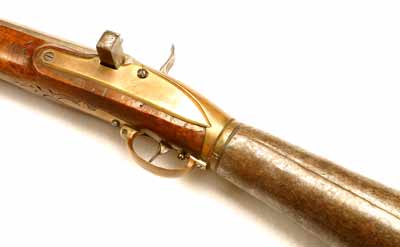
Fig.2. Left side of the Beeman Girandoni, loading block protruding in resting position. Note: note the sling swivel loop and the lack of an air release bypass lever, features characteristic of military versions of the Girandoni system. The metal air reservoir, which also served as the gun's buttstock, was screwed onto the male thread of the receiver (see figure further below). A gasket, cut from a cross section of a cow's horn (the best "plastic" of the period!) and very carefully honed to have exactly parallel, smooth surfaces, served very well as an air seal between receiver and reservoir. Horn was the best "plastic" of that period for the purpose -an almost perfect compromise, between hardness and malleability, for sealing the involved air pressures. Beeman collection and photo. ©2002, Robert David Beeman
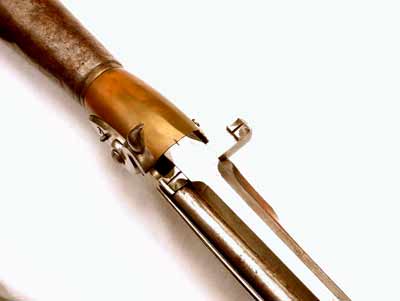
Fig. 3. Beeman Girandoni - showing tubular ball magazine on right side of gun, distinctive loading block traversing the receiver. Note that receiver casting is a single, seamless top piece. Beeman collection. ©2002, Robert David Beeman
Figure 4. Inside view of the Beeman Girandoni military air rifle lock with hammer in the resting position. The heavy flat mainspring extends along the forward two thirds of the lock plate. This unusually strong mainspring allowed much greater stored air pressure than a V shaped spring (thus allowing the potentially higher power of the Girandoni design.). The boat shaped air release wedge and striker latch are visible along the bottom rear edge of the lock plate. Note the shaft of a drift punch, restraining the mainspring, just barely visible below the large hole which is bisected by the forward edge of the hammer. Recent study of this mainspring has shown it to be a replacement. (Note that this replacement mainspring has two "hash marks" chiseled in its left edge - a gunsmith would generally try to mark replacement parts to match the assembly marks of the original. The original assembly marks, however, are two round punch marks like those visible on the inner surface of the lock plate, below the mainspring. They are more easily visible in the photo below where the mainspring has been removed.) The tumbler wedge, sear bridle, and sear lever are evident to the right. Beeman collection. ©2002, Robert David Beeman
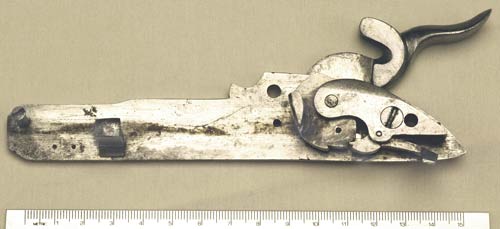
Fig. 5 Inside view of same airgun’s lock, without mainspring. Note the tumbler and sear in full-cock position. The bridle at upper right holds these parts in their proper relationship. Beeman collection. ©2005, Robert David Beeman
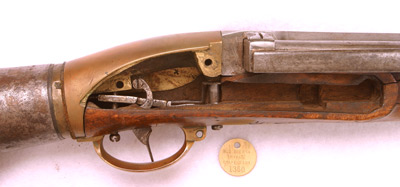
Figure 6. Girandoni repeating air rifle with lock plate removed. Note that only the upper part of the one piece receiver is solid cast metal. Stock wood and the separate trigger guard form the bottom half of the receiver a potentially weak area of the design. Note that stock wood which was immediately behind the loading slide is missing. The brass Beeman Museum disc (Number 1360) is 7/8" (22 mm) in diameter. ©2002, Robert David Beeman
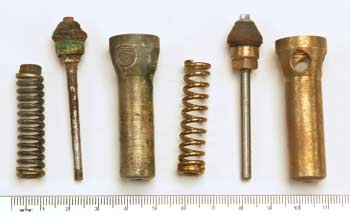
Figure 7. The combination air intake/exhaust valve from the front of the Girandoni air reservoir. This assembly is housed in the valve body between the iron air reservoir and the bronze receiver in the above picture. Such valves, with a single coil spring around a valve spindle with a valve seat at the forward end, were common in butt reservoir guns for many years prior to the Girandoni airgun. This valve, from Girandoni's shop in the 1790's, has the identical structure, including the same exact 60 degree slope of its shaped stack of three layers of leather, as the Schraeder (Schrader) valve that was "invented" and patented by George Schraeder in 1871! The Schraeder valve is the common tire valve of today. The actual Girandoni airguns are unusual in having a coil spring made of brass – very advanced for the period and difficult to make. The three parts at the left are from the original Beeman Girandoni; the three parts on the right were made in 2004 by Ernie Cowan for a museum copy of this gun. Beeman collection and photo. ©2005, Robert David Beeman
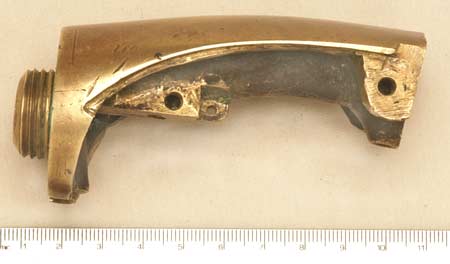
Figure 8. Receiver of the Beeman Girandoni military repeating airgun. Almost surely this key part had been sandcast in bronze. Only the separate trigger guard parts, and stock wood to be added later, form the bottom half of the receiver. Note the tiny bit of lower lock plate support ledge, at the far left side of the receiver cavity, which allows easy alignment and assembly of the lockplate into the finished gun. This highly functional “little Girandoni notch” is diagnostic of the airguns which followed the original Girandoni design in the decades following its introduction – it appears on several Girandoni style single shot and repeating air rifles and shotguns in the Beeman Collection. Beeman collection and photo. (More details on the receiver of the Girandoni airguns, and information on modern reproduction of the Girandoni repeating airgun are presented in the Austrian Antique Airguns section of this website.) ©2005, Robert David Beeman
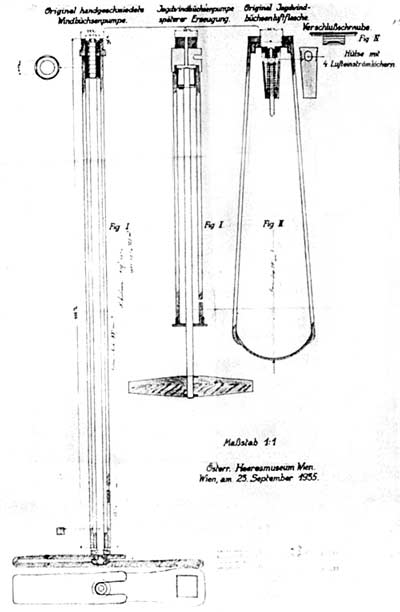
Fig. 9. Original drawings of the Girandoni military air rifle hand pump and air reservoir. The extremely long thin pump at the left must have been clumsy to carry in the field; but the photo of the Girandoni support pack system from Turin makes it clear that the soldiers did carry them. The long pump has a snap-off foot pedal/combination tool which could be held to the ground with the user’s boots. By moving the cylinder up and down while it is attached to the pump, air could be pumped[4], into the air cylinder. The head of the piston consisted of a stack of seven, oiled leather washers.[5] Note that the little cross sectional view at the top left shows that the full diameter bore of the pump continued right out to the end as the vent hole of the pump. This reduces the lost volume at the end of the pump, which needs to be kept to a minimum as air is compressed into this space as well and just expands again when the pump is extended.[6] These long, special high-pressure hand pumps could have been used to completely charge the air reservoirs but may have been mainly used to top off the pressure of partially pumped and partially expended bottles which otherwise would present a continuing problem to the individual soldiers. A pump like the shorter, larger diameter pump shown is similar to the air pumps of most airguns and air canes. Such a pump could have been used in the Girandoni shop and away from field action, to produce high pressures to test the air reservoirs. The small diameter of the air vent passage would allow much higher pressures, with much greater effort, to be put into the tanks for testing.
These most unusual long pumps really reveal the genius of Girandoni. With almost no dead space, these pumps would be extremely efficient and allow rapid pumping - but their large bore size would prevent the field soldier from over-pumping the air rifle - this causing his rifle to improperly function or even to cause the air tank to explode. Note the brass thread protection device in the upper right hand corner.
Heeresgeschichtliches Museum, Vienna. (Hummelberger and Scharer, 1964)
The Girandoni military air rifle is a butt reservoir air rifle with a rifled bore diameter of 0.452” (11.48 mm) , groove diameter 0.462" (11.73 mm) (personal communication, Ernst Cowan, 2005; bore diameter of about 0.450" determined by author prior to insuring the Beeman Girandoni on 2 December 1978 ). The proper pure lead ball was 0.464" (11.79 mm) caliber of 154 grains (10.01 gms) or 45 balls per pound. This was the popular "11 3/4 mm" caliber of that period. Rifling is twelve grooves with one turn in about two-thirds of a meter (26.25"). As noted in the Rodney account, the reservoir indeed has an unusual “bag” shape. This conical iron air reservoir serves to hold a supply of highly compressed air and to act as the rifle’s buttstock. An external tubular magazine, along the right side of the barrel generally was described as holding 20 lead balls which are gravity fed (without a magazine spring or follower) to a transverse loading bar at the breech end of the barrel. However, with a ball in the firing socket of the loading bar, our specimen has a total ball capacity of 22 balls. The correct magazine capacity evidently is 21 balls. A flat spring running the length of the outside of the magazine holds the loading bar to the left. When the gun is held muzzle up and the left end of the loading bar is pushed by the shooter, the bar moves to the right, and a cavity within the bar receives a ball by gravity from the magazine. The ball is moved into firing position behind the barrel as the magazine spring is allowed to push the loading bar back to the left[7].
Until now, we did not have a good understanding of the internal operation of a Girandoni air rifle. This lack of solid information led to considerable confusion and error. Thanks to the recent exhaustive work of Baker, Currie, Cowan, and Keller, we now have a clear picture of the internal operation of this airgun. (It is imperative that anyone, seeking to understand the mechanism of this gun, obtain a copy of the 2006 version of Baker and Currie's 2002 work.) Presented here, for the first time, are color diagrams, by Geoffrey Baker, of the functioning of the ingenious lock and valve system of the Girandoni repeating air rifle. These are vital in our attempt to identify the Lewis airgun.

Figure 10. Mechanism of Girandoni military repeating air rifle. AT REST. This, and all following drawings, are scale drawings by Geoffrey Baker, based on two British specimens and cooperative information and images of the Beeman Girandoni air rifle from Robert Beeman and Ernie Cowan. Images reproduced courtesy of Geoffrey Baker and Colin Currie.
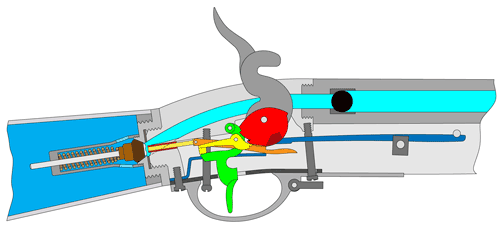
Figure 11. Hammer pulled back to point where striker latch is about to jump up and engage wedge on tumbler and sound the first click of cocking. Flintlock guns do not have a striker latch so they do not sound a click at this point.
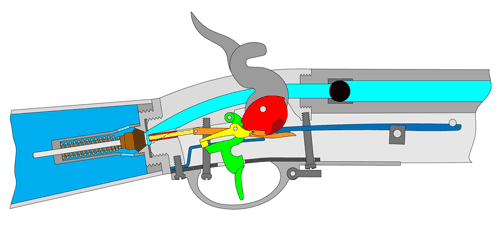
Fig.12. Hammer pulled back to point where sear engages half-cock notch on tumbler. Second click. Hammer may be left in this “safe” position. In this mode the trigger should not be able to allow the hammer to fall and cause the gun to discharge.
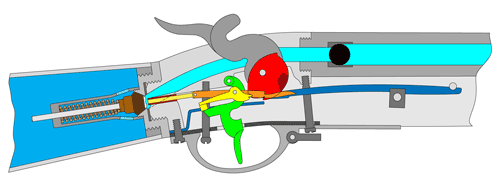
Figure 13. Hammer pulled back to engage sear in full cock notch. Third click. Gun is now ready to fire whenever trigger is pulled.
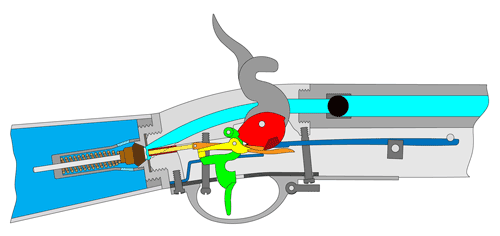
Figure 14. Trigger pulled, allowing hammer to start forward and have tumbler wedge engage notch of striker latch. This wedge will push the striker assembly against air valve and start to release compressed air from reservoir
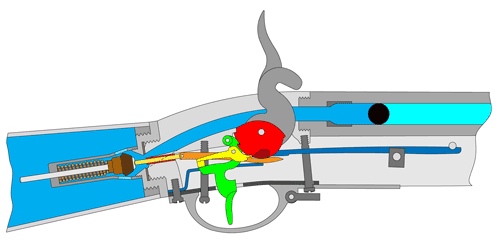
Figure 15. Tumbler wedge is beginning to push on the striker assembly which has started to force open the air valve in the reservoir. Air pressure is building and starting to force the ball up the barrel. The wedge will be forced out of the striker latch notch as the tumbler’s wedge rotates further, clockwise, to the rear.
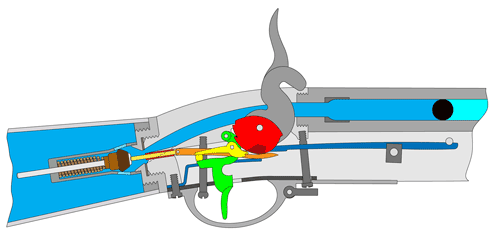
Figure 16. Wedge is now rising out of the latch notch. Air valve is fully open. High pressure air is forcing the ball up the barrel. In the next stage the wedge will move back and slide out of the striker latch notch. The air pressure and the valve spring in the reservoir will then force the air valve shut. The hammer will then move forward and return to the rest position as shown in the first figure above.
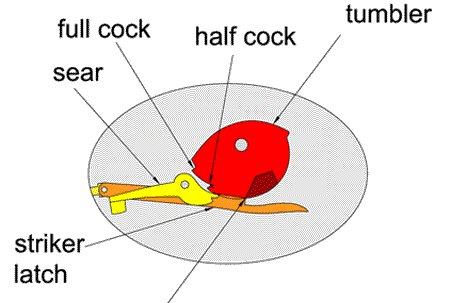
Fig. 17. Detail of first click when cocking. As the hammer turns the tumbler counter-clockwise during cocking, the striker latch (orange) is snapped up as the rear lip of the tumbler wedge passes the point at the tip of the lower arrow. Firearms lack a striker latch, therefore firearms do not produce a click at this point during cocking.
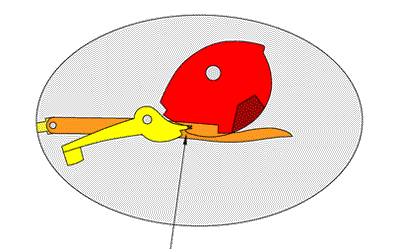
Fig. 18. Detail of second click when cocking. As the tumbler turns counter-clockwise, the sear (yellow) snaps into the normally deep half-cock notch at the tip of the lower arrow. The depth of this notch normally prevents the sear from coming out of the notch. This prevents the gun from discharging and serves as a “safe” position. Note that the second click in a typical firearm of the period would indicate that the gun is ready to fire and a shooter not familiar with this quirk of Girandoni airguns might pull the trigger very forcefully in this mode, perhaps even to the extent of breaking off the safety ledge of the airgun’s half-cock notch. Early production of the Girandoni air rifles did not have a half-cock position.
Fig. 19. Detail of third click. As the tumbler rotates counter-clockwise, the sear tip snaps into the full-cock notch at the point of the arrow. The gun will now discharge when pulling the trigger causes the sear to slip out of this shallow notch. Note that this would be the second click position in a typical firearm of the period.
Figure 20. Exposed detail of hammer at forward rest position. Tumbler rebound stop is resting flat on the mainspring. Note the roller bearing on the back of the tumbler; a very advanced feature for the period. Several parts removed from drawing, and lower part of hammer made transparent, to aid clarity.
Figure 21. Exposed view of cocked hammer and mainspring. Tumbler is pushing down mainspring into its cocked, tensed position. Pulling the trigger allows the sear (yellow) to move out of the full cock notch and release the potential force of the mainspring to push against the rear section of tumbler and cause it to rotate around the tumbler pivot pin.
Figure 22. Detail of the striker assembly. (Upper diagram is a side view. Lower diagram is a top view.) When the air valve closes, propelled by high pressure air in the reservoir, it gives a sudden acceleration to the striker assembly. The striker latch guide screw limits the forward movement of the striker latch towards the barrel. Fig. 10 shows that this screw is supported at both ends to resist the beatings of the striker latch being driven forward. Its outer head is rounded for appearance and protection to the shooter’s finger. The striker latch guide screw does not have any adjustment role[8] Note that the striker latch is not symmetrical.
After moving a ball into firing position, the gun is cocked by pulling back on a hammer-like cocking lever. Moving the cocking lever back causes an internal tumbler on the inner end of the cocking lever (hammer) to force the mainspring down into a compressed position. The cocking lever is held to the rear, against the pressure of the mainspring, by the half cock or full cock sear notches. When the trigger is pulled and the tumbler is in the full cock position, the rearmost section of the trigger forces the sear out of the full cock notch. The released force of the mainspring forces the tumbler to rotate, bringing the tip of a wedge shaped part on the tumbler into the notch of the striker latch. The force of the mainspring is converted into a straight line motion as the wedge pushes the striker latch and thus the attached striker pin against the forward end of the air reservoir’s valve. The tip of the striker pin forces open the valve and releases a short blast of compressed air to force the ball up and out of the barrel. The wedge then slips past the striker latch and the air valve spring, aided by air pressure in the reservoir, forces the air valve shut and returns striker assembly back into its resting position. Movement of the wedge is reversed during re-cocking, depressing the striker latch and allowing the wedge to pass without disturbing the striker assembly and air valve. This all can be repeated so rapidly that all 22 balls could be fired in less than a minute.
It is significant that cocking the Girandoni produces three tactile and audible clicks. The first click occurs when the wedge engages the notch of the striker latch and the next two when the sear engages the half cock notch and then the full cock notch. Even an intentional pull of the trigger after just the first click would not release much, if any, of the compressed air from air reservoir. A conventional flintlock firearm produces only the two sounds and sensations of the half and full cock engagements. Thus a shooter, familiar only with flintlocks, could cause just two clicks on the airgun and think that he is in the full cock position and ready to fire. Actually, he would be in the half cock position (which also externally appears like the flintlock full cock position) and, in frustration, might pull the trigger hard enough to break the thin projection off the half cock notch. Such a broken half cock notch would only hold the sear in a precarious manner and could easily cause an accidental discharge.
The Girandoni lock system is a quite sophisticated, well-designed timed release design and the repeating mechanism reveals its genius by its efficiency and simplicity. Baker and Currie (2002) make the very interesting observation that there wasn’t another conventional military shoulder arm comparable to the firepower of the Girandoni repeating air rifle until the 1860 Spencer repeating firearm rifle of the American Civil War. However, the Spencer had only a seven shot magazine and had to be reloaded frequently by the rather clumsy Blakeslee loader. The Girandoni military air rifle had a magazine listed at 20 rounds. Each Girandoni-bearing military shooter was issued two extra air cylinders and four very efficient speedloader tubes, each containing twenty additional balls. A fully loaded Girandoni kit had eighty more of those large caliber balls ready for rapid action! In typical military use, discharged, or partially discharged, air cylinders would be exchanged for fresh full ones by runners going back and forth to stationary wheel pumps or special two axle wagons designed to carry up to 1000 pre-charged air cylinders, both positioned behind the combat lines. Certainly the soldiers were not going to fully pump up their three cylinders in regular use as this would require about 4500 strokes with the hand pump! Even a single cylinder could have taken a half hour of hard pumping action! The long slim pump, designed almost without dead space, would be especially useful in “topping off” high pressure in partially expended cylinders.
We really don't know if Captain Lewis had one of the actual Girandoni shoulder bags or not. Certainly he had an air pump. And, of course, it would have been necessary to have had the tools and bullet molds that were needed for the use of the airgun. So, I would expect that Lewis did have the shoulder bag of accessories, but that in the 41 years that this gun apparently sat around in the Lukens shop that the bag would become separated from the gun - and/or not recognized by the auction clerks as being related to this gun. Or, less likely, it may not have been left at the Lukens shop by whoever deposited the gun there for repair. Of course the pump and accessories probably would not have been stored with the air rifle in its rack and thus almost surely would have been separated from the gun at the time of gathering items for the Lukens estate sale. Almost no-one, at that time and place after the death of Lukens, would have understood that these parts belonged with the strange air rifle.
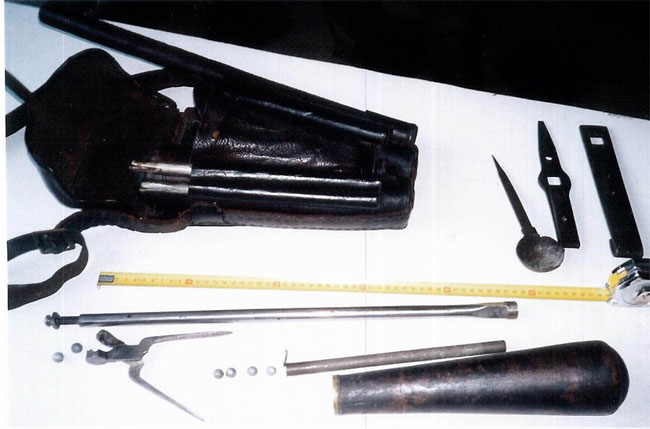
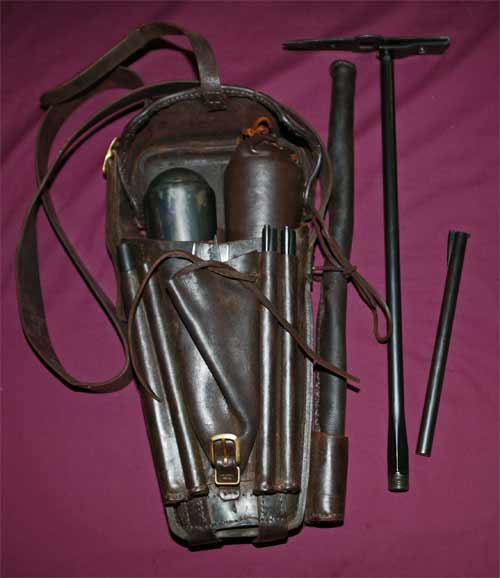
Figs. 23 and 24. The upper figure shows the only original Girandoni accessory pouch known to exist. Not shown is the leather cover which was slipped over the steel air cylinder in cold weather. (Original information and top figure courtesy of Giancarlo Melano, Museo Nationale Storico d'Artiglieria, Turin, Italy). Below is a museum grade copy of the Girandoni pouch, produced by Ernie Cowan and Rick Keller. The pump has its multi-purpose tool handle snapped into place, ready to be held to the ground by the feet of the shooter while he moves an attached air reservoir up and down about 1500 times! To the right of the pump is a closed speed loader tube holding 20 lead balls ready to be instantly fed into the airgun's magazine. Note that the right hand air cylinder in the pouch has the cold weather, leather cover on it. The whole assembly weighs about 16 pounds, almost twice the weight of the airgun! (Click on images for larger views.) . ©2005, Robert David Beeman
The
outstanding study of the history of the Girandoni Military Repeater Air Rifle by
Walter Hummelberger and Leo Scharer (1964) reveals that the success of the
Girandoni air rifle in warfare has been a mixed matter. Their
large German reports, so important to the better known publications of
Baer
(1973)
and Hoff (1977), reveals experience which is of great significance in our
considerations of the Lewis airgun. About 1780, the Austrian military
authorities, driven by Emperor Joseph’s personal involvement and great
enthusiasm for the Girandoni airguns,
secretly
had begun the development of the
so-called Austrian Military Model 1780 Repeating Air Rifle. By
August 24, 1787,
when Istanbul declared war against Russia, some air rifles and pumps were the
only things that were ready for war. It was realized from the beginning that it
might not be practical to provide all the compressed air for these guns from
little individual hand pumps. So Girandoni developed a wheeled pump to fill the
removable air bottles of the guns. Originally, it was planned to have one such
wheeled air machine for each five air rifles, plus the little hand pumps, but
only two of the wheeled pumps actually were produced[9].
Later, it was decided to issue a hand pump to only every other soldier,
underlining that the soldiers mainly were expected to depend on pre-charged air
bottles brought to them by runners. Girandoni developed a two axle wheeled
wagon, or transporter, to safely carry up to 1000 of the pre-charged air
bottles.
Emperor Joseph personally was involved in the most detailed matters of this
project and the combat. He realized early that the air guns must be “deployed
correctly and maintained at the best standard. It is necessary that the simple
soldier, whose intelligence is generally quite limited, is given this training
immediately upon receiving the gun – and that the training is delivered in
individual parts and not too much at once.” It was determined that two corporals
would have to be especially trained to train and supervise the rank soldiers in
the use of the Girandoni airguns. Thus every 20 air-riflemen would be supported
by these two special corporals plus a specially trained officer. In addition,
there would be a specially trained journeyman gunsmith for each 100 airguns and
a large supply of replacement seals, air reservoirs, mainsprings and other
parts.
Even with this intense support, there was considerable malfunctioning and poor
maintenance of the airguns. Emperor Joseph was soon complaining that “we appear
to have a miserable bunch of riflemen, none of who is suitable for service with
the air rifles.” By end of November 1788 the Emperor seems to have ordered that
the air rifles be taken away from the troops. The General Artillery Director,
the Duke of Colloredo himself, reported on
July 21, 1789:
“Due to their construction, these guns were much more difficult to use
effectively than normal, as one had to handle them much more cautiously and
carefully. In addition, the soldiers using them had to be supervised extremely
carefully, as they were unsure about the operation. The guns become inoperable
after a very short time – so much so that after awhile no more than one third of
them were still is in a usable state. We needed the whole winter to repair and
replace them.” After this it was deemed wise to take back the airguns and issue
them only to select, specially trained Tyrolean sharpshooter units. The last
order given by the Emperor prior to his death was “to select the most promising
and skilful soldiers to use these guns.” Because of extensive service work, and
most importantly, the lack of Emperor Joseph’s interest and involvement, the
airguns still had not been issued on December 16, 1792. However, the Tyrol Sharp
Shooter Corps indicated “that these weapons were really accurate and effective”
in the Turkish War and in 1790 against Prussia. The air rifles were later
supplied only with a behind-the-lines wheeled pump – the idea being that
captured airguns would not be very useful without the pumps!
Thus, the Girandoni air rifle in combat required persons highly trained in its use and supported by wheeled air pumps and wagons of pre-charged air bottles. These air guns easily were put of service and needed constant and expert tending. A Girandoni air rifle was predestined to give inexperienced users trouble and charging with individual hand pumps was punishing to the user. The dependability of the gun for lethal combat, under field conditions, especially without the backup of dozens of other airguns, was not high. None of this would have been evident to Lewis before the trip.
Power of the Girandoni Air Rifle
Because of the sophisticated nature of the flat mainspring and the timed release mechanism, Baker and Currie (2002) suggest that the Girandoni system is capable of much greater power than air rifles of less advanced design (such as the Lukens air rifles). As of May 2003 they were only willing to indicate that this system could project a lead ball, of about one-half inch diameter, of about 210 grains to a muzzle velocity of at least 500 fps for about 117 ft. lbs. of muzzle energy. Colin Currie reported (personal communication May 18, 2003) that the Royal Armories of Leeds, England recently charged the Heiberger .433 caliber air rifle, a formerly single shot air rifle made about 1750 but converted to a 23 shot Girandoni-style repeating system[10], apparently in the early to mid-1800s, to about 800 lbs/sq. inch and achieved a muzzle velocity of over 900 fps with balls of 120.4 grains for a muzzle energy of 217 ft. lbs. He reported that 1500 strokes were needed to pump up the Heiberger‘s buttstock reservoir to operating pressure after 20 shots had been fired from one charging/loading.
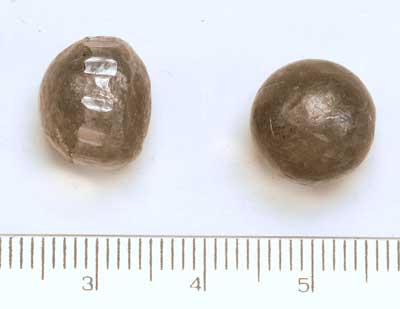
Fig. 25. Lead balls, 0.464 " (11 ¾ mm) caliber. Upper Right: unfired ball. Upper Left: Ball fired by the author into soft material from a Cowan museum copy of the Beeman Girandoni, 750 psi air pressure. This may be one of the first balls fired from a military Girandoni for the last century or two! Beeman collection and photo. ©2005, Robert David Beeman
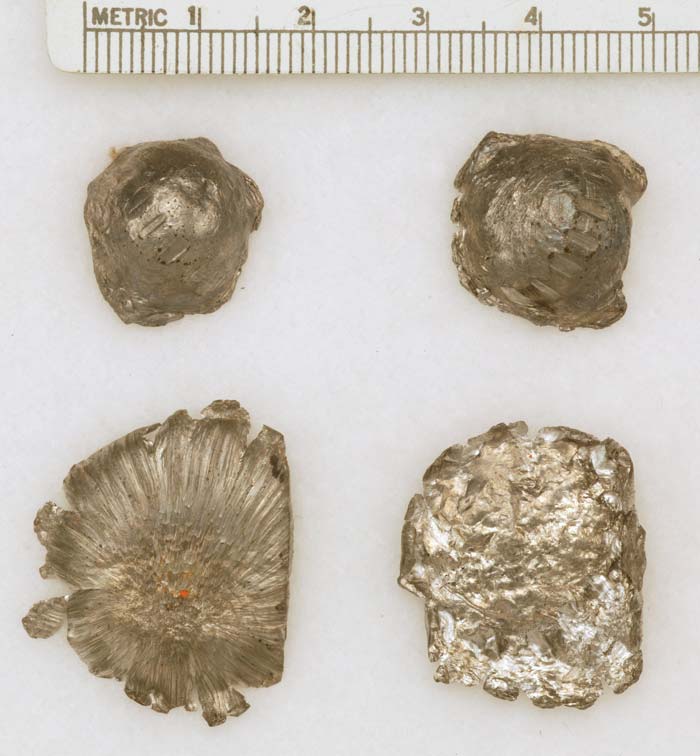
Fig. 26 Upper two balls fired against metal plate after about 20 shots; rifling marks are still visible. Lower two balls fired against steel plate at approx. 20 paces. Left: impact side. Right: Gun side. Maximum expansion is about 30 mm (approx. 1.17 inches)! Lethal stuff! Beeman collection and photo. ©2005, Robert David Beeman
Larry Hannusch (personal communication, Nov. 27, 2002) reported that he has fired his own large bore Girandoni-system rifle (a Lowentz) producing 200 ft lbs. muzzle energy at 750 psi pressure, but that a muzzle energy of up to 150 ft. lbs. would be more typical at conservative pressures. All references to the Girandoni air rifles mention lethal combat ranges of 125 to 150 yards and some extend that range considerably. Currie and Baker also suggest that the Girandoni system could operate well at pressures well above 1000 psi, perhaps to double of that, and that they feel that the working pressure as supplied by special pumps, and thus the potential power, of the original guns was far higher than the figures normally quoted. Keller and Cowan (personal communications 9 November 2004 and 14 February 2005) think that the original air reservoir pressures topped at about 800 psi. The potential muzzle energy might be more accurately determined from tests now underway with exact museum copies of these guns. Fred Baer (1973) suggested that the power could be in the .38 Special area of modern firearms, or even into the range of the .45 ACP cartridge, famous in pistols and submachine guns favored by police, gangsters, and the military for several wars of the 20th century.
The power levels discussed above were very potent for the period. However, foot pounds of energy do not tell the whole story. Few hunters today would venture after big game with the energy levels of the old big bore airguns or flintlocks, but those big lead balls, about a half-inch in diameter, have a special effect – as does a deadly arrow with “only” fifty foot pounds of striking energy. One has to respect a gun capable of shattering a huge lead ball against a distant steel plate, especially when a typical Girandoni system gun could deliver about 20 of those heavy missiles within the minute and another 80 rather suddenly! (With practice, one can simultaneously load the gun with action of the left hand and cock it with the right hand - enabling aimed shots to be taken about every 1 1/2 seconds!). The simple great inertia and large diameter of those big lead balls also makes them far more dangerous than paper figures would suggest. Walter Hummelberger and Leo Scharer (1964) relate a great deal of the feedback from the Austrian military about the Girandoni repeating air rifles. While there was considerable complaint about their reliability, there does not seem to have been any complaint about their lethal effectiveness - they must have been of power similar to the flintlock Jaeger rifles of the period! And the fact that Larry Hannusch (personal communication, Nov. 27, 2002) indicates that he has regularly used his Girandoni-system air rifle (a Lowentz, apparently with a less powerful mainspring and lacking its original magazine) in recent years to take the huge whitetail deer of eastern America is simple and clear proof of the lethal power of these big bore airguns.
High air reservoir pressures, translating into high power, could be an advantage in battle where charged cylinders were being shunted to and from the shooters. However, such pressures and volumes of air per shot for such large bore airguns present such a fearful appetite for compressed air that modern shooters of pre-charged pneumatic rifles resort to SCUBA tanks and motorized pumps for charging
Myths About the Girandoni Airguns
Not only is there a great deal of previous misinformation about the Girandoni repeating air rifles, but there are some recurring, quite incorrect, myths. These are discussed at more length in a large article in another section of this website (click on Antique Austrian Airguns ). Among the unfounded myths are: 1. These airguns were used against Napoleon. 2. Napoleon issued an order to put to death any soldier found carrying an airgun. 3. These airguns are completely silent.
Side Note on the Beeman Girandoni military air rifle:
We purchased our specimen from the private collection of an American antique gun dealer about 1975 without any provenance. The master gun reproduction maker/historians, Ernie Cowan and Richard Keller, made, over a two year effort, just four ultra precise, museum copies of the Beeman Girandoni (omitting the defects, of course, to allow proper function of the copies). . They are extremely impressed with the excellent craftsmanship, fitting, and especially the engineering of this specimen.. All key parts of the original and these copies are marked with matching assembly marks: a punched or drilled series of pits, diagnostic of the actual Girandoni guns. These are the same special military assembly marks found on other authentic specimens of the Girandoni military repeating air rifles which were assembled in workshop groups. The air reservoir bears what appears to be a copper coating, on its inside and outside surfaces - a feature evidently unique to the Girandoni produced airguns. In attempting to braze the seams of the museum copies of the air reservoirs, Ernie Cowan discovered that it was necessary to have the riveted parts extremely and very evenly hot. He found that very old gunsmith literature revealed that the early makers evidently accomplished this by immersing the entire white hot reservoir into a vat of molten brazing metal and removing it slowly. This allowed a slow and even cooling that prevented the cracks which had plagued Cowan in trying to make his first dozen or so air reservoirs. Such a method was easy for old time gunsmiths who often were also blacksmiths with an ever hot forge. And it would leave all surfaces of the reservoir with at least traces of the brazing metal!
Cowan and Keller, directly studying the Beeman Girandoni, indicates that not only are they convinced that this was one of the military models of the Girandoni military air rifles, made somewhere in the middle of the actual Girandoni production (construction details, such as the presence of a half cock, would place it about 1798), but that it probably was an actual combat-style model which was illegally possessed outside of the military circle. They feel that this is evidenced by the apparent removal of the serial number on what clearly is an authentic Girandoni military model. The receiver profile seems to be somewhat lower and thinner in the locations where the maker mark and logo and serial number would be expected and the front of the air reservoir end cap, where another serial number would be expected, appears to have been filed shorter. (Close examination of the side view shows that the front of this tapered brass piece falls a little short of the diameter of the adjoining receiver.)
The true military status of this wonderful specimen, as revealed by these previously unrecognized Girandoni assembly markings and exact measurements, was confirmed by the British airgun historians, Currie and Baker. These exacting researchers have become experts on the Girandoni repeating air rifles. Their conclusion is somewhat different. They feel that this airgun is an unmarked authentic military production specimen diverted to the civilian market. As noted, Girandoni was accused of diverting some specimens to the more profitable civilian market while he was paid on a per diem basis. (This was the reason his compensation was changed to a per gun basis!).
Some specifications of the Beeman Girandoni: Unloaded weight = 9.2 lbs (4.2 kg)., magazine loaded w/ 21 lead balls = 9.6 lbs (4.4 kg).. Weight of empty air reservoir assembly = 3.0 lbs (1.36 kg).. Overall length = 48.5" (123.2 cm). In 1978, when describing the gun for insurance purposes, I determined the that bore diameter, across the lands, was about 0.45". (Cowan later refined that, in 2005, to 0.452" [11.73 mm], groove size = 0.462" [11.79mm]. Ball size is.0.464" (11.79 mm) caliber. This is the traditional European 11 3/4 mm caliber of the period. Thus the 9.94" magazine would hold 21.4 of the lead balls. Ball weight is 154 grains (10.01 gms) or 45 balls to the pound. Rifling is twelve grooves with one turn in about two-thirds of a meter (26.25"), faster than most powder rifles of the period. This faster turn was a new feature among airguns to accommodate their higher velocity. Cowan notes that the barrel is of wrought iron, the rifling is excellent, and quite shallow (about 5 thousands of an inch), commensurate with high efficiency in an airgun.). The air valve consists of three stacked pieces of hard leather, cut to a 60 degree slope to match the slope of the brass valve seat. The front sight is brass or bronze. Finish of protected iron surfaces is a dull dark, hot bluing.
What is our background in this area of study? Mrs. Beeman and I have been intensely interested in antique large bore
airguns, especially the Girandoni system rifles and pistols, and the Lewis and
Clark airgun, for over three
decades. This began long before our interest in collecting and studying airguns
of the 20th century. During that time we have studied such airguns with the late
Henry Stewart (who started us on the trail to the Lewis airgun in January 1976) in his
astonishing gunroom, and in person in the collections at the Tower of
London (with the late Howard Blackmore as our incredibly knowledgeable guide), Beeman Airgun Collection, Virginia Military Institute, Smithsonian
Institute, U.S. National Firearms Museum, Fort Clatsop Museum, German National
Museum, Military Museum of Turkey, Kopenhagen Tøjhusmuseum (Royal Danish Arsenal
Museum, under the direction of the late Arne Hoff), Milwaukee Public Museum, Zurich Landmuseum, Bern Historical Museum,
Solthurn Zueghaus, Deutsch Jagdmuseum - Munich, Jagdmuseum Kranichstein -
Darmstadt, Waffensammmlung des Kunsthistorischen Museum and
Heeresgeschichtliches Museum – Wien, Staatliches Museum – Schwerin, Victoria and
Albert Museum – London, and several other important gun collections throughout
the world.. The Jagdmuseum Kranichstein in
Darmstadt, Germany and the
Heeresgeschichtliches Museum in Vienna, Austria were especially valuable in our
quest for information on this design. In most cases, Mrs. Beeman and I were allowed to
work in the private research facilities of the museums, in discussion with and
active participation of the arms curators, studying, photographing, and even
disassembling these amazing arms. In addition, we have studied airguns at
innumerable gun and airgun shows in
America and overseas and we carry on a long and vigorous exchange of information
with other museums and leading collectors all over the world. A great deal of
study has been done in the Beeman collection, which includes several models of
the Girandoni design. Antique large bore airguns are the main emphasis of the
Beeman Collection; it apparently is the world’s largest such collection.
In addition to developing a reference library on these guns, I have had the
wonderful opportunity to study original references in person at many museums
around the world and
at the U.S. Library of Congress. Only a minor amount of the basic literature
about the Girandoni-system airguns is available in English- and some of that is
represented by very weak material in secondary sources, such as W.H.B. Smith,
Eldon Wolff, and especially such popular general audience works as Nonte and
Wesley. I have concentrated on the key works, which are in German.
I have also studied some of the less important papers which are in Italian and
even French. It is only too clear that many of the so-called references are
simply wrong, have incorrect dates, and have repeated popular myths about these
guns. (For instance, virtually everyone had been repeating centuries-old misinformation about caliber,
magazine capacity, and air bypass mechanisms.) Some of Baer’s writings, though
wonderful and often original, continued to repeat incorrect information. (As
does some of the material in Joe Mussulman’s truly outstanding Lewis and Clark website – he is committed
to updating those few points soon.). The great recent work on the structure and
function of Girandoni airguns by
Geoffrey Baker and Colin Currie (2002) has undergone further fine tuning. This because
of photographic distortion, lack of access
to certain parts of the museum specimens, and mistakes in the literature on
which they were depending. The second edition of their work (2006), an excellent
revision, is essential to anyone wanting to recreate, or even just
understand, these special guns. We were delighted to have had a hand in
this revision by supplying them with very
detailed information on, and high
resolution images of on the Beeman Girandoni and information from our studies..
Colin Currie, flew to the USA in December 2005 to examine the Beeman Girandoni,
museum quality reproductions and castings of this gun, and to confer with master
gunmaker Ernie Cowan and gun historian Rick Keller who recently made those breakthrough discoveries
which they feel identify the Beeman Girandoni as the THE Lewis and Clark airgun.
It is our sincere hope that Cowan, Keller, Currie, Baker, and Beeman,
finally working together as a team, will produce the most through and
accurate information pool ever available on this incredible gun design - a design
which was far ahead of its time.
Important Note: This material will be expanded and updated at www.Beemans.net. All updates supersede any earlier material.
New Chapter:
THE FOLLOW-UP
NEWS FLASH: What is being said about the Beeman Girandoni around the world??:
For a more complete list of references, please scroll on to near the end of this paper.
Beeman, Robert D. 2006. Meriwether Lewis's Wonder Weapon. We Proceeded On. May 2006, 32(2): 29-34. Lewis and Clark Trail Heritage Association. On the Beeman Girandoni: “this rifle, in fact, was the one carried on the expedition.”
Beeman, Robert D. 2007. Air Power Diplomacy: Lewis’s Assault Rifle. Blue Book of Airguns, 6th Edition, pp. 16-22. “New study …..has not only removed all of the objections to such a rifle being carried by Captain Meriwether Lewis but has identified the actual rifle”.
Eichstädt, Ulrich 2007. Corpus delicti, Die Suche nach der Lewis & Clark Windbüchse. (Body of Evidence -The Search for the Lewis & Clark Airgun), VISIER Jan.2007:135-143. Europe’s leading airgun historian and author says: “the puzzle about the legendary airgun carried by Captains Meriwether Lewis and William Clark from 1803 to 1806 appears to have been solved.”.
Fincham, Christopher. 2006. Lewis and Clark rifle donated to AHEC. The Carlisle Barracks Banner. Oct. 2006, Vol. 12(10): p. 9. "The historic Girandoni air rifle that research indicates was carried by Meriwether Lewis and William Clark...". ""there is no other weapon in American history that can compare with this one - neither the technology that it represents, the expedition it accompanied, or the role it played within that expedition."
Franz, Linda. 2006. Historic air gun coming to AHEC. The Sentinel. Sept. 26, 2006, p. B1-4. "historic detective work done by expert Pennsylvania gunsmiths Rick Keller and Ernie Cowan discovered that the gun in the Beemans' collection had undergone repairs that matched exactly the type of repairs made to the gun after it was damaged during their trek, as described in Lewis and Clark's journals." "Rick Keller and Ernie Cowan of Chambersburg.....discovered signs the gun was the one carried by Lewis."
Owen, Ron 2006. A Military Rifle for a Military Expedition – The Key to the American West, pp. 354-365 in Chapter 6,.Air Arms Training, Use and History. Range Officers Hand Book. Queensland Indoor Air Rifle Association, 24 McMahon Rd, Gympie 4570, Queensland, Australia. "...here is an actual rifle which meets all the criteria of not only the Lewis & Clark records but also those of the Rodney account and the Lukens auctioneer account." "...this indeed is the very air rifle carried by Captain Lewis."
Saunders, Tim. 2006.. History Maker, Airgun World Oct. 2006, pp. 47-59. British report on the Beeman Girandoni: “The weight of new evidence is such that few doubt that it is indeed the actual Lewis and Clark rifle.”
Schreier, Philip 2006. The Airgun of Meriwether Lewis and the Corps of Discovery. American Rifleman, Oct. 2006: pp. 66-69, 86, 97-99. Schreier is the Senior Arms Curator at the prestigious National Firearms Museum of the NRA. His headline notes that the matter of the Lewis airgun was a mystery - "until now" and although he notes that we can never be 100% sure that the Beeman Girandoni is the Lewis airgun, he clearly states that “the circumstantial evidence is overwhelming”.
Zimmerman, Tom. 2007. Priceless piece of Army history donated to Army Heritage Center. The Carlisle Barracks Banner. June 2007, Vol. 13 (6): pp.3, 6. "The Lewis and Clark Air Rifle, one of the most historic pieces of Army history, was donated to the Army Heritage Education Center Foundation..." "Especially important were the extremely strong professional opinions in favor of this rifle's role in the L&C expedition, expressed by John Giblin, Curator, and Christopher Semancik, Arms Curator, both at the U.S. Army War College's Army Heritage and Education Center at Carlisle Barracks, Pennsylvania."
POST SCRIPTS
23 November 2004:
In confidence, this research paper was accepted for publication, to appear in a much condensed form, by We Proceeded On, the official publication of the Lewis and Clark Heritage Trail Foundation, Inc. - the key Lewis and Clark publication. (It finally appeared in the August 2006 issue of this quarterly journal.)
23 March 2005
It was agreed among those involved in this study that this material would be held in confidence until it could be well reviewed and then formally presented to the public at the prestigious Baltimore Antique Arms Show, the “Crown Jewel” of Arms Shows, on March 19-20, 2005 by Robert Beeman, Ernie Cowan and Rick Keller. The presentation of both the Beeman Girandoni which Cowan and Keller have found is apparently the Lewis and Clark Airgun, and the Corps of Discovery's "Short Rifle", the U.S. Model 1800/1803 flintlock rifle, were very well received by the very knowledgeable members, arms curators, and guests of the Maryland Arms Collectors’ Association. This is a tremendous, wonderful show and should not be missed by any arms collector!
Image of Silver Award Bowl (to be posted)
Mrs. Beeman and I were stunned and overwhelmed to have the critical judges of the Maryland Arms Collectors’ Association awarded us the “Best Individual Weapon” silver bowl for the Lewis and Clark Air Rifle– this is considered the “Best of Show” award; their top award- (The other awards are handsome glass plates). The exhibit itself, built by Ernie Cowan and Rick Keller, also featuring the U.S. Model 1800/1803 Lewis and Clark flintlock Short Rifle, was awarded First Place for Educational Exhibits.

Fig. 1. Dick Berglund (left), President of the Maryland Arms Collectors' Association, upon decision of a select panel of expert gun historians and arms curators, awarded the silver bowl, the top award of the Baltimore Arms Show, to Dr. Robert Beeman for the air rifle which evidently is indeed the airgun carried by Meriwether Lewis. Photo by Toshiko Beeman. ©2005, Toshiko Kanzaki Beeman
Dick Berglund, who presented the silver trophy, commented on one of the “world's greatest adventures, the Lewis and Clark Expedition, and the ONE GUN that made it possible!” Many commented that not only was this a major historical matter, but that it was a huge boost for American airgunning. This was the first such award ever made for an airgun and it was awarded by one of the world’s largest arms collecting organizations, a group that, like most arms collectors' groups in the past, largely has ignored airguns as having any particular significance!
An authentic museum copy of the Girandoni military air rifle field accessory pouch, produced by Ernie Cowan, was displayed at this Baltimore Antique Arms Show. Copied from the only known surviving original pouch in Turin, Italy, this unit, which weighs 18 lbs. fully loaded, contains the special high pressure Girandoni air pump, four 20 ball speedloaders, two extra air reservoirs (one complete with leather winter sheath), ball mold and lead ladle, and tools.
As visitors to this display at the Baltimore show know, the museum copies by Ernie Cowan are just incredible – made using all original techniques and materials with simply astonishing workmanship. Three of the museum copy guns were made exactly as were the original guns, except for rifled barrels of modern steel. Only our museum copy specimen Number 4 is exactly like the original Beeman Girandoni air rifle, complete with a rifled barrel made from 200 year old wrought iron[31]. Our museum copy is as if it had just arrived from Girandoni’s shop. (Ernie indicated that additional copies are not planned and orders will NOT be taken.)
Interestingly, the Lukens shop and its men are still a very critical part of the Lewis and Clark air rifle story. And, our research about the Lukens air rifles is far from wasted; it has been noted that this research is the pioneering core of what we know about this very important early American shop and its wonderful air rifles.
Actually, undertaking a detailed opposition to the idea of a repeating air rifle on the Voyage of Discovery, has been an excellent exercise. We may well have presented virtually all of the key possible objections to a Girandoni as the Lewis and Clark airgun. Thus we were able to line up the key objections and consider them right now, rather than later when presented by someone else.
20 May 2005:
Mrs. Beeman and I have just returned from a wonderful trip to the US Army War College in Carlisle, PA- we were the spoiled guests of the U.S. Army for 5 days. John Giblin, Chief Curator, and Chris Semancik, Arms and Ordnance Curator, of the museum at the Army Heritage and Education Center (AHEC) at Carlisle Barracks War College, the Maryland Arms Collectors Association awards board, European experts on the Girandoni, Colin Currie and Geoffrey Baker, Lewis and Clark scholar/researcher Jay Rasmussen, leading American airgun collector and author, Larry Hannusch, and many others, had carefully reviewed our web paper, and other information on the matter, and conclude that this airgun apparently is the one carried by Capt. Lewis.
Because the Corps of Discovery expedition, led by Captains Lewis and Clark, was indeed a military expedition, General David Huntoon and COL Craig Madden, Commandant and Deputy Commandant of the War College, were so enthused about the new evidence on the Lewis air rifle that they requested a cross country trip, all expenses paid by the U.S. Army, for Tosh and myself. In addition, they transported the Beeman Girandoni airgun by special high security transport – one would have thought that they were moving the Bill of Rights. Just the travel and security costs for the gun, from California, alone were over $3000! They wanted it and us there for their big Army Heritage Day event on May 14, 2005 and they also took us to speak at the Maryland Arms Collectors Association Meeting on May 13, 2005 ( the gun was moved by the Army, highly secured, in an Army security van, guarded every minute, followed by a pursuit car!)
The General had also requested a firing demonstration on May 12, 2005 for the press and army staff – we did this with the now completed museum copy G1, an extremely exact copy, made by master craftsman Ernie Cowan, of the Beeman Girandoni. (Cowan and Keller are the gunsmith/historians who discovered that the Beeman Girandoni evidently is the actual Lewis airgun.) The shooting demo was a tremendous success and the media folks were extremely impressed! Ernie, dressed as Captain Lewis, gave a Lewis-style shooting demo and then invited all to shoot it. Everyone was thrilled and in awe to actually have a chance to fire the gun. Those 154 grain lead .464 caliber balls, fired every two or three seconds, completely flattened out by their impact, caused some bulging eyeballs and many sounds of astonishment! (A repeat of the reactions of the "naive" Indians over 200 years ago!). The reporters related to it as the “Assault Rifle” of the period and to its use as part of the expedition’s “shock and awe” impression and “firepower diplomacy” to the Indians.
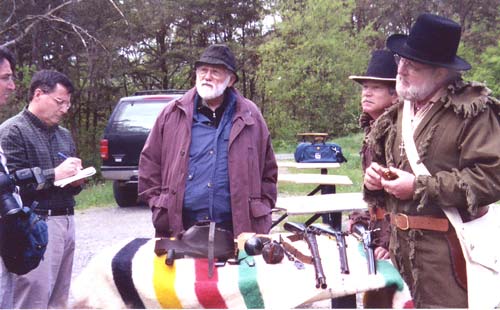
Fig. 2. Meet the Press. Army War College, 12 May 2005. L to R: unidentified reporters, Robert Beeman, Rick Keller, Ernie Cowan. Photo by Toshiko Beeman. ©2005, Toshiko Kanzaki Beeman
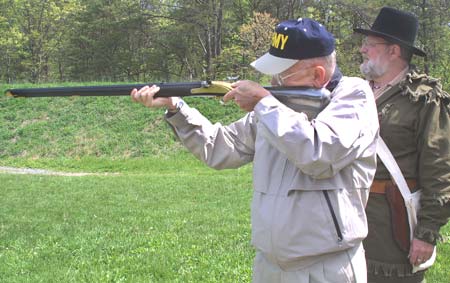
Fig. 3. General Hal Nelson fires the first museum copy of the Beeman Girandoni military repeating air rifle. The gun's maker, Ernie Cowan, watches.
Photo by Toshiko Beeman. ©2005, Toshiko Kanzaki Beeman
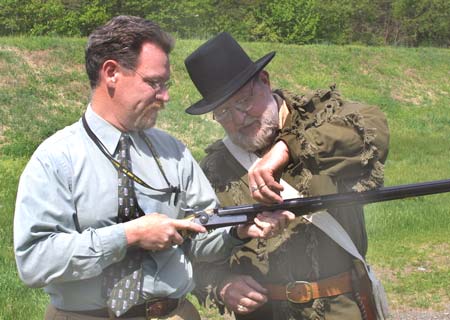
Fig. 4. War College Chief Curator John Giblin gets some firing tips on the Girandoni museum copy from "Captain Meriwether Lewis" ( Ernie Cowan) ©2005, Toshiko Kanzaki Beeman
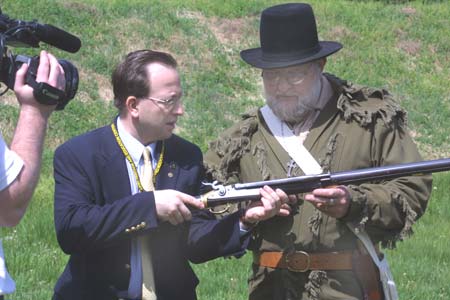
Fig. 5 War College Arms & Ordnance Curator Chris Semancik gets ready to fire the Cowan/Keller museum copy of the Beeman Girandoni. "Captain Meriwether Lewis" (Ernie Cowan) and the press look on. Photo by Toshiko Beeman. ©2005, Toshiko Kanzaki Beeman

Fig. 6. "Captain William Clark" (Rick Keller) explains features of the Keller/Cowan museum copy of the U.S. "Model 1800" - now believed (Keller and Cowan, 2006) to be the "Short Rifle" flintlock model specified by Captain Lewis for the expedition. Photo by Toshiko Beeman. ©2005, Toshiko Kanzaki Beeman
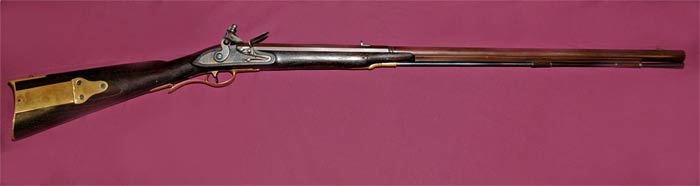
Fig. 7. Cowan museum copy of the US Model "1800" Short Rifle - one of the 15 flintlock "Short Rifles" made for Captain Lewis for the expedition. Although marked 1803, this is NOT the same US Model 1803 which previously has been claimed to have been produced for Lewis. A handy 49 inches overall, it is delightfully easy and fast to handle - perfect for such an expedition! Caliber is .53", firing a .52" caliber lead ball. Rick Keller and Ernst Cowan have presented a very convincing research paper (Keller and Cowan, We Proceeded On, May 2006) about these guns.. This elegant museum copy was made by Ernest Cowan. Cowan also made one firing museum copy specimen of this Short Rifle for Dr. and Mrs. Robert Beeman as a demo firing mate to the museum copy of the Beeman Girandoni air rifle.. Photo by Robert Beeman. ©2005, Robert David Beeman
The Army War College was extremely interested in the Beeman Girandoni. The Lewis airgun is of great military and arms interest in itself but as one of the ONLY surviving relics of this tremendously important expedition, it is of unique importance. They will maintain it under 24 hour Special Forces guard in a new high security building which meets national archive standards for fireproofing. They want to make it the centerpiece of a display on Army weapons of great historical significance. It was again noted that it may well be the most important individual gun (of any kind!) in American history. We couldn’t refuse – it would be safer there than here. (The Lukens airgun at VMI already had military protection, but of a lower level because of less certainty of it being the Lewis airgun.)
This sure is giving a boost to the credibility of airguns – most of the reporters and visitors didn’t have a clue that airguns meant anything more than BB guns! And it was such a delight to see reporters, even a female reporter (not a gun enthusiast!), thrilled about learning about, and even firing, a big bore AIRGUN!
July 28-31, 2005:
LEWIS AIRGUN WINS THE "GRAND SLAM" OF GUN COLLECTOR AWARDS
It is said that winning both of the Best Gun and Best Exhibit awards at both the Baltimore and Kansas City Gun Collector Shows is the GRAND SLAM of gun collecting awards. So we were incredibly delighted to win both of those awards at the NRA National Gun Collector Show in Kansas City on July 29-31, 2005! Duplicate trophies were awarded to Ernie Cowan/Rick Keller for their discovery of this gun as the Lewis airgun and its display and to its owners/researchers, the Beemans. The judges told us that out of the possible 300 scoring points, the highest rating ever had been about 285. Think how amazed we were to receive a score of 305 - the judges had added a bonus of 5 points! The judging panel was most enthusiastic in accepting this Girandoni repeating air rifle as the actual Lewis air rifle!
Again, this was the first time that any airgun had ever won these prestigious prizes - airgunning and airgun collecting got another super boost!
(Thanks to the U.S. Army War College for providing high security transport of the Lewis airgun to and from the Kansas City show.)
Mrs. Beeman and I were especially pleased to receive the following note from one of the NRA show judges at the Kansas City show:
Dear Bob & Toshiko;
It was a pleasure to meet you at the NRA’s National Antique Gun Show in Kansas City. As the NRA’s judges of the exhibits, I have to tell you that Deb, Frank, and myself were in full agreement that your exhibit on the Lewis & Clark air gun was indisputably the highlight of the show. Not only that, it may well mark a historical landmark in research and exposition on the Lewis & Clark Expedition. Bravo and congratulations – not only for the discovery but for the thoughtful and meticulous manner in which you people have examined and presented the evidence in this case. I have to say that behind the scenes at the show the judges all agreed that the nature of your exhibit “gave us goose bumps.” That is a difficult thing to achieve.
Just to let you know, after the show I shared news of these achievements with Steve Allie and George Moore (curator and exhibits director) at the United States Army’s Frontier Army Museum at Fort Leavenworth, Kansas, and with my old friend Dan Gagliasso – producer/director for the History Channel (currently shooting a piece on the Comanche). With any luck you will find yourself chatting with one or more of them in future.
Once again, congratulations on your present and past achievements and much deserved recognition. I hope we shall meet again in the future. By the way, Toshiko’s art is marvelous. My wife too is an artist specializing in large paintings using dyes on silk – techniques which she studied in Japan – and so she was delighted to see Toshiko’s work.
Sincerely,
Frederick J. Chiaventone
Frederick J. Chiaventone
Author, screenwriter, commentator
Lewis and
Clark Airgun Returns Home!
Robert and Toshiko Beeman donate the Beeman Girandoni to the
U.S. Army War College.
Tosh and I returned from a very tiring, but wonderful, trip to Pennsylvania– to pick up our museum copy of the Beeman Girandoni Austrian military repeating air rifle, painstakingly made over the last two years, using original methods and materials to produce a masterpiece which is almost as if it had just come out of the 18th century Girandoni shop, by the brilliant arms craftsman, Ernie Cowan (himself a "National Treasure"), and to donate our original specimen to the U.S. Army War College. We, and Ernie Cowan and Colin Currie (the British co-author of the new Girandoni construction manual), had a barrel of fun shooting the NEW Girandoni – it could rapid-fire 65+ of those big, heavy caliber .464” (11.75 mm), 154 grain lead balls on one charge of air and still be deadly! We will be testing it on massive blocks of clear ballistic jelly and the new Swiss forensic “skull bone” simulation plates at Sweetwater Valley Ranch.
The donation matter was a very big decision for us. We are now feeling how it feels to give up the star item of a collection developed over four decades; a wonderful and beloved artifact which had become like a family member. Sure, we have an elegant substitute, but think how it would feel to receive a substitute- born and raised elsewhere – for your own son or daughter. The emotional impact surprised even us! Our accountant was appalled at our decision – he felt that we could have sold it for a huge amount on auction – perhaps millions – since even a terribly beat up, much less important, gun from Custer’s Last Stand has sold for close to a million – just due to its historical connection! We finally simply decided that the most important thing is that this gun goes back to where its fame and importance began: the US Army. Soooo- we donated the Beeman Girandoni repeating air rifle, now recognized by the top officers and curators of the U.S. Army War College, and so many other gun experts and historians, as THE Lewis and Clark Air Rifle, to the Army War College Heritage and Education Center, in Carlisle, Pennsylvania, on September 25, 2006. This donation, and the donors, of what the leading Army arms curators announced is the “Most Important Individual Gun in American History” (any gun, not just airgun!) and a “National Treasure”, were honored by three major events, with over 150 key people attending, including several generals, the area's leading arms curators, the leaders of the Maryland and Pennsylvania Arms Collectors Associations, many media reporters, arms experts, etc.. On the second day, Mrs. Beeman and I each addressed the staff of the Heritage and Education center and their invited special guests – the Army communication folks even projected my website so that I had wall size illustrations to accompany the talk. Especially important were the extremely strong professional opinions in favor of this gun’s role in the L&C expedition expressed by John Giblin, Curator, and Christopher Semancik, Arms Curator, both at the U.S. Army War College’s Army Heritage and Education Center (AHEC) at Carlisle Barracks, Pennsylvania.
This is the very center of the U.S. Army War College and their huge developing Army Heritage and Education Museum complex. Their strong professional opinions and their HUGE desire to have this gun led to our surprise donation. The War College’s Heritage and Education Center has big plans to make it the centerpiece of their wonderful new museum complex- they pointed out that the Beeman Girandoni is the only connection that the Army can display to the Lewis and Clark expedition – which in turn, as noted in detail since 2005 on our website, may well be the reason that the USA now extends from “sea to shining sea” as every school child sings! It is now felt that this gun is the reason that the Lewis and Clark expedition was able to return – and if they had not returned the United States would have missed a tiny window of opportunity to develop an interest in the Western American areas while the Native Americans were still terribly decimated and various European powers had not yet been able to nail down their claims to these areas.
Perspectives of the Lewis air rifle have very recently changed completely due to the evidence revealed since 2005! While it formerly had been considered just as an interesting curiosity, like a compass or a kaleidoscope, without great significance, now historians describe it as the most important item on the expedition and perhaps the very reason for the expedition's success and survival!
Articles on the Beeman Girandoni airgun have now appeared in the May 2006 We Proceeded On (the official Lewis and Clark publication, by Robert Beeman, edited by Jim Merritt), October 2006 Airgun World (by Tim Saunders), October 2006 American Rifleman (by NFM Senior Arms Curator Phil Schreier), an Australian gun guide (by Ron Owens), a Washington gun collecting guide, and in VISIER (by Ulrich Eichstädt) – the leading German arms magazine (far more elegant and excellent than any American gun magazine!) – and a range of newspapers, websites, and TV programs – more are in preparation. (The American Rifleman copy appeared complete with support for the Girandoni/Napoleon myth – which I had edited out in a draft sent to me! Ulrich Eichstädt, the VISIER editor, is distressed by that, as they have been trying to kill that myth for decades!). More details about the role of the Beeman Girandoni on the Lewis and Clark expedition of 1803-06 are given in the Lewis Airgun-New Evidence section of this website and in the Antique Austrian Airguns section (which even illustrates our .46 caliber specimen of a modern version of a Girandoni-system repeating airgun made for use by European partisans against the Nazi occupation in WW2) (see Index of this website.)
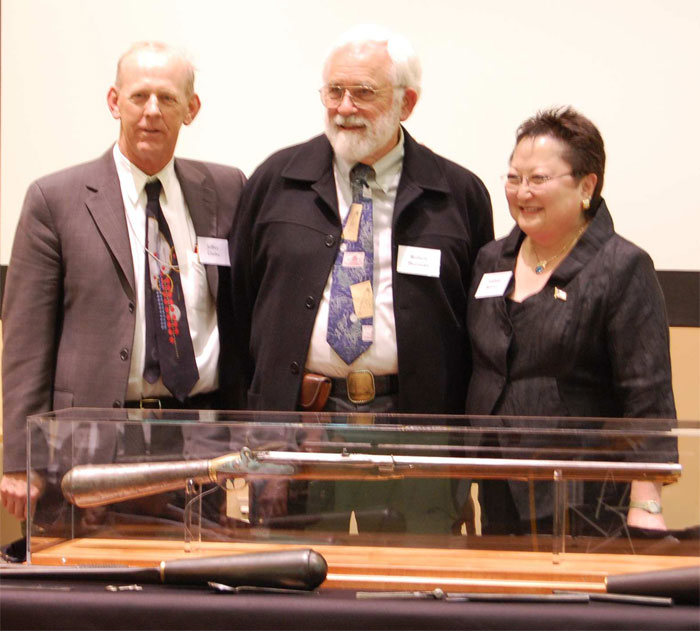
Fig. 8. Left to Right: Dr. Jeffrey Clarke, Chief Historian of the Army, representing General George Casey, Chief of Staff of the Army, receiving the Beeman Girandoni Repeating Air Rifle, on behalf of General George Casey, Chief of Staff of the U.S. Army, from Dr. Robert D. Beeman and Mrs. Toshiko K. Beeman. Foreground: the hero of this decades long story: the Beeman Girandoni, acclaimed as the rifle which Captain Meriwether Lewis carried across the wilderness of NW America in 1803-06.{Photo courtesy of Mike Perry, Executive Director of Army Heritage Center Foundation.)
FINAL
STEP IN DONATION OF BEEMAN GIRANDONI AIR RIFLE,
AS THE LEWIS AND CLARK AIRGUN, TO U.S. ARMY WAR COLLEGE.
Transfer to
General George Casey,
Chief of Staff of the Army
Mrs. Beeman and I returned from a wonderful ceremony marking the final transfer of our Beeman Girandoni Military Repeating Air Rifle to the U.S. Army War College in Carlisle, Pennsylvania. For protocol and legal reasons, the first step was to donate our gun to the Army Heritage Center Foundation (AHCF) on September 26, 2006. They in turn loaned it to the National Firearms Museum of the National Rifle Association for public display until May 17, 2007. On May 18, 2007, at a grand U.S. Army ceremony at the Army Heritage and Education Center (AHEC) at the U.S. Army War College, the Beeman Girandoni, accepted by the Army arms curators and historians as the original Lewis and Clark air rifle, was formally transmitted to General George Casey, Chief of Staff of the U.S. Army. Representing General Casey, accepting it for the U.S. Army War College, was Dr. Jeffrey Clarke, Chief Historian of the Army. Presiding over the meeting was Mike Perry, Executive Director of the AHCF.
General Robert Scales, past director of the Army Heritage and Education Center, thanked the Beemans for their "very historically significant" donation and spoke about the plans of the AHEC to develop an Army Museum as a major expansion of the present research and display facilities. Their plan is to present the Beeman Girandoni as a pivotal item in the Army's role in the Western Expansion of the United States. Robert Beeman spoke of the change in perspective, after the recent identification of the Lewis airgun; of its shift from historical curiosity to being described as a "National Treasure" and "The Most Important Gun in American History" - how it apparently affected the successful Western expansion of the U.S.A. The guest list, of over 500 military VIPs, historians, arms curators, gun experts, collectors, AHEC members, media representatives, etc., included a wide range of VIPs from far and near. Special guests of honor were Ernest Cowan, master gun maker and Richard Keller, gun historian, who not only uncovered the first internal clues in this gun which led led others to a general consensus that they had indeed found the Lewis Air Rifle, but who built four extremely authentic museum copies of the Beeman Girandoni, Warren Lee from California, the artist who did the commissioned painting "Air Power Diplomacy" featuring the Beeman Girandoni, and - all the way from England - Colin Currie - one of the co-authors of the new book on the structure and function of Girandoni air rifles. American airgun collectors were represented by several key persons including Fred Liady and Marvel Freund. Marv presented a delightful trophy, commemorating this event, to the Beemans . The ceremony was followed by a reception, hosted by the U.S. Army, and a VIP tour of the facilities, . We went away with a sense of deep satisfaction - a feeling that "our baby", the former "Crown Jewel" of the Beeman Airgun Collection, was VERY well appreciated and would be well preserved and well presented to future generations!
WHERE CAN YOU SEE IT??
The Beeman Girandoni repeating air rifle was on display at the National Rifle Association's National Firearm Museum until May 2007. It then moved to the U.S. Army War College, Army Heritage and Educational Center, at Carlisle, Pennsylvania. Best to call first, as it sometimes is put into highest security and there are plans to put it on display for some months at the Pentagon. The AHEC planned display area which will feature this gun has not yet been built.
NOTE: Additional material on Girandoni airguns, and some details on the production of the museum copies, is presented on this website, just click on: Antique Austrian Airguns .
Finally, An Accurate Picture of the Lewis Airgun in Action:
Air Power Diplomacy -Captain Lewis' "Assault Rifle"- The Key to the
American West.
: Private
Whitehouse noted in his journal entry of August 30, 1804 when Captain Lewis
demonstrated his airgun to a large group of Yankton Sioux in the Calumet Bluff
area along the Missouri River:
"Captain Lewis took his Air Gun and shot her off, and by the Interpreter told
them there was medicine in her, and that she could do very great execution. They
all stood amazed at the curiosity; Captain Lewis discharged the Air Gun several
times, and the Indians ran hastily to see the holes that the Balls had made
which was discharged from it. at finding the balls had entered the Tree, they
shouted a loud at the sight and the Execution that was done suprized them
exceedingly."
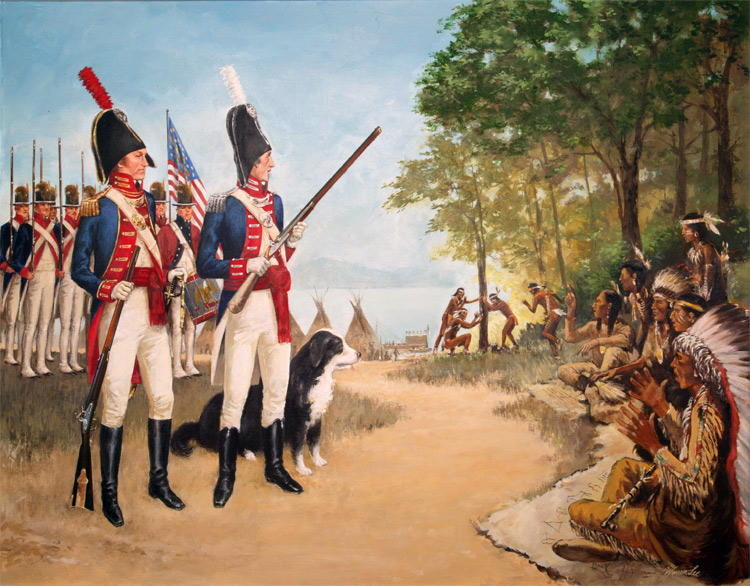
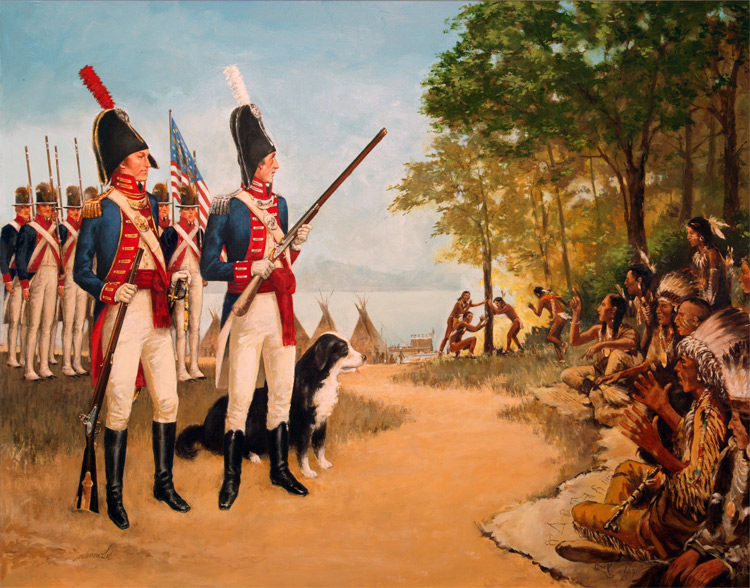
Painting by Warren Lee
.©2005, Robert David Beeman
Quiz- Just for historical fun: Name 14 ways that the lower, latest, politically correct painting differs from the original above it. List of answers below.
Oil painting, by Warren Lee, commissioned and specified by Robert Beeman, 2005. It may well jar some viewers to see the expedition members decked out in such military finery instead of "mountain men" clothing - but we must remember that this was a full-scale military operation and that Lewis and Clark did indeed have and use their dress uniforms and all possible pomp and circumstance when intending to impress the natives. Some of the details represent the uniforms of a small window of time, but these are almost surely correct: As Bud Clark, the great-great-great grandson of Captain Clark, has pointed out, there "has been much debate over head gear. We know from surviving specimens what Officer Chapeaus of the period looked like. However, they were in vogue for a very short time when the size of the Army was at is smallest, and consequently we do not have an abundance of paintings, illustrations, etc. to refer too. The consensus in the 'L&C Fraternity' is that Chapeaus for the Captains are appropriate", however they normally would not be worn "Napoleon" style as shown, but rather angled across the right eye. That position would interfere with sighting the rifles, so we have shown these hats in the cross position for this firing demonstration. Note the correct red and white hat plumes for Lewis and Clark, who certainly were not unaware that these huge hats, with their high plumes, not only gave them an imposing appearance, but much greater height than anyone else! It is interesting to note that Captain Clarks' dress buttons and jacket piping were gold, while those of Captain Lewis are silver - as shown.
The arrival of the expedition to this area was rather dramatic: Captain Clark wrote that "We set the Prarie on fire, to let the Soues Know we wished to see them"!
This painting intends to give a somewhat stylized depiction of an airgun demonstration near a densely populated Yankton Sioux settlement on Calumet Bluffs with the participants having stepped out from a "a Council under an Oak tree near wher we had a flag flying on a high flag Staff" to a clear firing area. On the right, we see several high ranking Sioux and part of their honor guard. Captain Clark recorded that "The number of Soues present is about 70 men". (Also present were some young Sioux boys - not shown - who had an archery match to determine who would get the beads that the captains presented.)
In the middle we see several braves who have run forward and are so astonished to see and call out that the balls have entered the target tree. In the distance we see other natives who perhaps are keeping an eye on the expedition boats. There are many tiny historical details shown - such as the long white tail on the American flag flying from the river boat and the expedition's honor guard flag with a red stripe running along under the blue star field - instead of today's white stripe to blue field orientation, the soldiers with their long arms on their left shoulders, and the sleeveless shirts, open top leggings, and the circular "Sioux" style of headdress (without trailers) on the ranking Indians. Clark mentioned that the clothing of the Indians was "verry much dekerated with porcupine quills". In “Quill and Beadwork of the Western Sioux”, Carrie Lyford notes that red, yellow, and black were the only natural dye colors used by the Sioux on quillwork before the advent of the white man. However, the Teton and Yankton Sioux already had a good trading relationship with the British, most notably represented by Hugh Heney, by the time Lewis and Clark had reached them. Therefore we can add blue to the list as the Sioux boiled blue cloth with quills to obtain blue quills.
Three things are introduced in this view of a full ceremony military demonstration: The Girandoni repeating military air rifle held by Captain Lewis, the U.S. Model "1800" flintlock "Short Rifle" held near the muzzle by Captain Clark, and Seaman, the Newfoundland dog owned by Meriwether Lewis. Seaman generally has been shown as a bulky, all black dog as a Newfoundland from a 20th century dog show would have appeared. Here he is shown as the breed was depicted by a 1790 dog book. (The variety of structure and color of older strains of Newfoundland dogs has been very well covered in Joe Mussulman's outstanding "Discovering Lewis and Clark" website at http://www.lewis-clark.org/content/content-article.asp?ArticleID=2519 ). Our special thanks to Jay Rasmussen ,Joe Mussulman, Bud Clark, Carolyn Gilman, David Halaas, and many other airgun, military, and Lewis and Clark experts who have provided, and continue to provide, input and corrections to this painting during its development. However, I must take full responsibility for any remaining errors.
One of the historians, who provided several details, observed that when writing one can be vague or even ambiguous – but a painter cannot. The consensus now seems to be that we can never know all the details of the actual scene, but that this painting is a good presentation of an event that we know did occur- and it was the event that was important.
A philosophical note: The path running through the center of the scene might be considered to symbolize the huge gap in the communication and perspectives of the Indians and the expedition members.
How do the original (upper) and the
latest painting (lower) differ?:
1. Soldiers moved rifles to left shoulder. As per Army drill of the period.
2. Braves lost their incorrect head bands. Sorry, Hollywood!
3.Head dress train, incorrect for period, blocked from view.
4.Another Indian chief added to foreground to hide the above head dress train.
5.Trousers of seated chief changed to leggings - correct for the period.
(Now he shows some leg skin!).
6.Sleeves eliminated on chief and far seated Indian.
7.Far seated Indian now has a bracelet.
8..Drum has been eliminated. They probably had a drum - but it was never noted
in the journals.
9. Former drummer now has new jacket and chest straps.
10. Added detail to middle of short rifle held by Clark.
11.Closed powder pan to ready position on Clark's short rifle.
12.Boat near shore changed to canoe. The boat had been sent back before this
stop.
13. Moved artist Warren Lee's signature from under chief at right to be under
Clark's foot.
14.Lighten sky behind soldier's rifles.
Other changes not easily visible in this size image.
Want a copy of the Air Power Diplomacy painting? Outstanding copies of this painting, up to 22" x 33 ", are available at a fraction of our overall cost. These have been reproduced from the original by the Giclée (pronounced “Gee- clay”) method on actual art canvas. The results are so good that we have to look for the position of the artist's signature to tell the original from the copies! See the very end of this section for details and costs.
SELECTED REFERENCES
See also the reference lists at the end of the other Lewis airgun chapter and the Antique Austrian Airguns chapter on this website.
Ambrose, Steven E., 1995. Undaunted Courage. Simon and Schuster. N.Y.
Baer, Fred 1955. The Gun That Scared Napoleon. GUNS, March 1955.
Baer, Fred. 1973. Napoleon Was Not Afraid of It. Pp. 250-257 In: Arms and Armor Annual, Ed. By Robert Held, Digest Books, Northfield, Illinois.
Baker, Geoffrey and Colin Currie, 2002, 2006. The Construction and Operation of the Air Gun. Vol. 1. The Austrian Army Repeating Air Rifle. 64 pp. colin.currie1@virgin.net and geoffrey.baker@virgin.net . This book, one of the most important works ever on the Girandoni air rifle, primarily consists of detailed drawings of the gun and its parts. It was heavily revised and corrected to include new work by Baker, Currie, Cowan, Keller, and Beeman as a second edition of 102 pages published in 2006. The stellar second edition of this book is absolutely essential to anyone interested in the Girandoni airguns. A similar book detailing the construction of aircanes has also been produced by this industrious and exacting pair.)
Beeman, Robert D., 1977. Four Centuries of Air Guns. Chap. 2: 14-25 in Air Gun Digest. DBI Books, Northfield, Ill.
Beeman, Robert D., 1999. Airguns Through the Centuries. Pg. 2 in Beeman Precision Airgun Guide, edition 22. Beeman Precision Airguns, Huntington Beach, CA.
Beeman, Robert D. 2000. Proceeding On to the Lewis & Clark airgun. Airgun Revue 6: 13-33.
Beeman, Robert D. 2002.” Proceeding On” to the Lewis & Clark Airgun. In: 2nd Edition of Blue Book of Airguns, pp. 50-77. A much updated and revised version is available at www.Beemans.net.
Beeman, Robert D. 2004. Did Meriwether Lewis Carry an Assault Rifle? In:4th Edition of Blue Book of Airguns, pp.49-64. Updated at www.Beemans.net .
Beeman, Robert D. 2005a. New Evidence Points to the Lewis and Clark Air Rifle – an “Assault Rifle” of 1803. Addictive Airgunning. March/April 2005. Approx. 50 pages. Subscription based web magazine.
Beeman, Robert D. 2005b. The Lewis and Clark Air Rifle - A Preliminary Note on New Evidence. in fifth edition of Blue Book of Airguns, pp. 34-35.
Beeman, Robert D. 2006. Meriwether Lewis's WONDER WEAPON.. We Proceeded On. May 2006: 32(2): 29-34. Lewis and Clark Trail Heritage Association. On the Beeman Girandoni: “this rifle, in fact, was the one carried on the expedition.”
Beeman, Robert D. 2007. Air Power Diplomacy: Lewis’s Assault Rifle. In 6th Edition of Blue Book of Airguns, pp. 16-22. “New study …..has not only removed all of the objections to such a rifle being carried by Captain Meriwether Lewis but has identified the actual rifle”.
Calloway, Colin G. 2003. One Vast Winter Count - The Native American West before Lewis and Clark. University of Nebraska Press, Lincoln and London.
Carrick, Michael F. November 2002: Meriwether Lewis’s Air Gun, We Proceeded On, pp. 13-19 and January 2003: Meriwether Lewis’ Repeating Air Gun, Gun Report, pp. 28-36.
Demmin, Auguste 1869. Die Kriegswaffen, pp.556-558, 976, Leipzig.
Eichstädt, Ulrich. 2005. Wer Wind sät...("Sow the wind..."), VISIER, Dec. 2005, pp.114-120.
Eichstädt, Ulrich 2007. Corpus delicti, Die Suche nach der Lewis & Clark Windbüchse. (Body of Evidence -The Search for the Lewis & Clark Airgun), VISIER Jan.2007:135-143. Europe’s leading airgun historian and author says: “the puzzle about the legendary airgun carried by Captains Meriwether Lewis and William Clark from 1803 to 1806 appears to have been solved.”.
Feldhaus, F.M. 1905. Zur Geschichte der Windbüchse and Das Luftgewehr als Kriegswaffe. Zeitschrift für Historische Waffenkunde. Dresden.
Fincham, Christopher. 2006. Lewis and Clark rifle donated to AHEC. The Carlisle Barracks Banner. Oct. 2006, Vol. 12(10): p. 9. "The historic Girandoni air rifle that research indicates was carried by Meriwether Lewis and William Clark...". ""there is no other weapon in American history that can compare with this one - neither the technology that it represents, the expedition it accompanied, nor the role it played within that expedition."
Franz, Linda. 2006. Historic air gun coming to AHEC. The Sentinel. Sept. 26, 2006, p. B1-4. "historic detective work done by expert Pennsylvania gunsmiths Rick Keller and Ernie Cowan discovered that the gun in the Beemans' collection had undergone repairs that matched exactly the type of repairs made to the gun after it was damaged during their trek, as described in Lewis and Clark's journals." "Rick Keller and Ernie Cowan of Chambersburg.....discovered signs the gun was the one carried by Lewis."
Gaylord, Tom 1997. The Girandoni Air Rifle. Airgun Revue 1: 10-11.
Haller, August 1891. Die Östreichische Militär Repetier Windbüchsen des vorigen Jahrhunderts. Organ der militärwissenschaftlichen Vereine. (Wien). 42:34-45.
Harrison Jr., Charter, 1956a. The Lewis and Clark Air Gun. Gun Report, May 1956: 6-8, 26, 34-35.
Harrison Jr., Charter, 1956b. More on the Lewis and Clark Air Gun. Gun Report, June 1956: 28.
Harrison Jr., Charter, 1957. Re-Inquiry into the Lewis and Clark Air Gun. Gun Report, Nov. 1957: 14-15, 30-31.
Hummelberger, Walter and Leo Scharer. 1964. Die österreichishce Militär-Repetierwindbüchse und ihr Erfinder Bartholomäus Girandoni. Part 1: Pp. 81-95.1965: Part 2:24-53. Zeitschrift fur Historische Waffenkunde. Deutscher Kunstverlag, München, Berlin. (This paper was also the basis for Fred Baer's excellent 1973 paper, which corrected many of the mistakes of his unfortunate1955 paper, but still led Hummelberger and Scharer to repeat many of the standard errors about the Girandoni military repeating air rifle - such as the caliber.)
Miller, 2007 tbd
Moulton, Gary E. ed. 1986-2001. The Journals of the Lewis & Clark Expedition. Univ. of Nebraska Press, Lincoln, Nebraska.
Owen, Ron 2006. A Military Rifle for a Military Expedition – The Key to the American West, pp. 354-365 in Chapter 6,.Air Arms Training, Use and History. Range Officers Hand Book. Queensland Indoor Air Rifle Association, 24 McMahon Rd, Gympie 4570, Queensland, Australia. "...here is an actual rifle which meets all the criteria of not only the Lewis & Clark records but also those of the Rodney account and the Lukens auctioneer account." "...this indeed is the very air rifle carried by Captain Lewis."
Rothenbücher, C. 1816. Über den Brand der Gewehre. Zeitschrift für dem Forst und Jagdwessen im Königreich Bayern 4: 40-42.
Saunders, Tim. 2006.. History Maker, Airgun World, Oct. 2006, pp. 47-59. British report on the Beeman Girandoni: “The weight of new evidence is such that few doubt that it is indeed the actual Lewis and Clark rifle.”
Schäfer, Otto, 1961. Die Windbüchsen im Museum Kranichstein. Deutsche Jäger Zeitung.. January 1961:436. Melsungen, Germany.
Schreier, Philip 2006. The Airgun of Meriwether Lewis and the Corps of Discovery. American Rifleman Oct.2006: pp. 66-69, 86, 97-99. Senior Arms Curator at the prestigious National Firearms Museum of the NRA says that, just we as can almost never be certain of the provenance of any antique gun, we can never be 100% positive that the Beeman Girandoni is the Lewis airgun, but he does stress that the matter of the Lewis airgun was a mystery "until now" and that “the circumstantial evidence is overwhelming”!
Smith, Dwight L. and Ray Swick, editors, 1997. A Journey through the West. Thomas Rodney’s 1803 Journal from Delaware to the Mississippi Territory. Ohio University Press, Athens, Ohio.
Stewart Jr., Henry, 1982. Transcript of an unpublished talk, in Philadelphia, Pennsylvania, to the 1982 Annual Meeting of the Lewis and Clark Trail Heritage Foundation. 14 pages.
Støckel, Johan F., 1978-82. Revision edited by Eugene Heer: Heer der Neue Støckel. Internationales Lexikon der Büchsenmacher, Feurwaffenfabrikanten und Armbrustmacher von 1400-1900. 2287 pp. Journal-Verlang, Schwend GmbH, Schwäbish Hall, Germany.
Thwaites, R.G. (Editor). 1904. Original Journals of the Lewis and Clark Expeditions, 1804-1806. Dodd and Mead & Co., N.Y. (Reprint Edition, Arno Press, 1969).
Train, J. Karl 1844. Die Niederjagd in allen ihren Verzweigungen vol. 1:28-32. Ulm, Germany.
Wood and Thiessen, 1985. p. 330 of two volume edition (1889-1890) of Masson's Les Bourgeois de la Compagnie du Nord-Ouest; recits de voyages, lettres et rapports inedits relatifs au Nord-Ouest Canadien.
Wolff, Eldon 1958, Air Guns. 198 pp. Milwaukee Public Museum Publications in History 1. Milwaukee Public Museum, Milwaukee, Wisconsin.
Zimmerman, Tom. 2007. Priceless piece of Army history donated to Army Heritage Center. The Carlisle Barracks Banner. June 2007, Vol. 13 (6): pp.3, 6. "The Lewis and Clark Air Rifle, one of the most historic pieces of Army history, was donated to the Army Heritage Education Center Foundation..." "Especially important were the extremely strong professional opinions in favor of this rifle's role in the L&C expedition, expressed by John Giblin, Curator, and Christopher Semancik, Arms Curator, both at the U.S. Army War College's Army Heritage and Education Center at Carlisle Barracks, Pennsylvania."
[1] Dr. Robert Beeman is a Lewis and Clark Trail Heritage Foundation member, Professor Emeritus at San Francisco State University, founder of Beeman Precision Airguns, publisher and chief author of Airgun Journal and Airgun News, author of many airgun and scientific publications and bulletins, airgun designer, airgunsmith, senior author of the Blue Book of Airguns series, expert airgun witness, airgun consultant, airgun historian, and joint owner, with Toshiko Beeman, of the Beeman Airgun Collection – one of the world’s largest airgun collections, specializing in pre-1900 airguns.
[2] This information is as given by Thwaites (1904). The much more respected rendering of the journals by Moulton states: “In a memorandum, penned in St. Louis in 1806, William Clark notes a number of articles and contents of boxes being forwarded to Louisville [KY] in care of a Mr. Wolpards. Among the contents of Box No. 2 is listed "1 air gun" (Moulton, Vol. 8, pg. 419).
[3] Americans now tend to pass over this “little war” in their thinking, but can we imagine how preoccupied the American public must have been when the USA had just been invaded by a foreign power, the White House burned, the capital sacked, and the invader was poised to take over the US government?
[4] “Rapping” is the quick snapping of the cylinder down against the pump to top off the air that can be entered by regular pumping. Rapping in air vs. pushing it in can be compared to hammering in a nail vs. pushing it in with a hammer. For many years I have been "rapping" higher pressures into Yewha and other pneumatic guns than could have been predicted on the basis of my tenth-of-a-ton weight. (Both Barnes and Gaylord, have since reported -via personal communication of October 20, 1999 - that such "rapping" can indeed produce air storage pressures greater than would be predicted from the body weight of the shooter. The weight of the shooter may be almost irrelevant in determining the air pressure that he can produce.)
[5] An intriguing feature of these pumps is their ingenious design: the upper end of the pump shaft is square in cross section. After pushing the pump head out for cleaning and oiling the seals would be pulled just into the pump’s bore. Then the square shaft passing through a square guide cap would hold the shaft still as the threaded pump seal nut was turned to expand the seals, thus providing perfect fit and tightness.
[6] Geoffrey Baker (personal communication, 10 November 2004) commented: The shorter larger diameter pump would not reach as high a pressure as the longer thinner one. The air vent does give some lost volume which is not so much of a problem at lower pressures, Girandoni very cleverly got over this by continuing the pump tube right up to the end. Air cane pumps are similar to the shorter one and the air vent is relatively large. Modern pumps like the Slim Jim variety used by the now defunct Brocock Company had a tiny air vent but they are designed to pump to much higher pressures than the aircane ones. Girandoni was a genius. For high pressure it is essential to have as little lost or “dead” volume as possible.
[7] A wonderful feature of the loading bar is its imperceptible taper. The largest end contains the firing socket for the ball. When the bar is the firing position, it fits exactly into the square opening through the barrel. The fit is so snug that virtually no air would be lost during the millesecond of pressurization during firing. When one pushes the bar to the left for loading the next ball the very slightly narrower size of that section of the bar allows easy, fast movement.
[8]. The impact of firing seems to loosen this screw.
[9] Girandoni reported that the wheeled pumps actually were a bit slower than the long hand pumps, but even though the filling of an air bottle would require the same amount of energy input from a wheeled pump as from a hand pump, the wheeled pump must have been enormously easier to use. It is staggering to think of the amount of manpower that would have necessary to keep those transporter wagons full of hundreds of fully charged air bottles, plus shunting them to the shooters. This alone could have been a key reason for the decline of the airgun as a regular military weapon.
[10] Almost surely, only one such conversion has ever been made. The Heiberger/Girandoni conversion gun had been stored in Schloss Dyck (Dyck Castle, near Düsseldorf, Germany) until 1992 and apparently has never left Europe. There is no indication that a Heiberger airgun, listed by Wolff (1958) as being in the Mack collection in America in 1958, ever was anything but an original single shot airgun. It evidently is the only Heiberger known to have ever been in the Americas.
[11]
One of the two Lukens air rifles at Virginia Military Institute is
marked “C. Sellers”. Coleman Sellers (1781-1834) was a friend and
son-in-law of the famed artist Charles Willson Peale. Peale, several of
Peale’s friends, and Isaiah Lukens socialized with Captain Lewis during
his visit of to Philadelphia. The marking of Coleman Sellers name on the
barrel of the Sellers airgun may be very significant. Typically, that is
the location of the barrel maker's name. Coleman and Isaiah were both in
their early twenties; both had fathers of great mechanical ability and
accomplishment. (Coleman's father, Nathan Sellers, had been commissioned
by George Washington to make the first paper making molds in America. By
the end of the Revolutionary War Nathan had become wealthy from that
business and had branched out into other manufacturing). Martin Orro has
suggested (personal communication 14 October 2004) that it is very
likely that Coleman and Isaiah, both young mechanics and inventors in
the closely-knit Philadelphia area, became friends and developed a
mutual interest in airguns. Bronze barrels of small caliber and with
high groove count rifling apparently were not known in the Americas at
that time. Coleman may have used his father's manufacturing import
connections to obtain some barrel blanks from Europe.
Evidently the Sellers used steam engines in the family mills before the
turn of the 19th century. Thus they possessed facilities for production
of pressure tank parts. Coleman later developed locomotive boilers.
Coleman could have used this interest and their factory facilities to
copy the air reservoir from an ordinary external lock airgun. Seneca
Lukens' knowledge of pattern making and brass foundry techniques would
have been a natural base for his and/or son Isaiah's work on developing
the receivers and other cast parts. The air valve springs and bolts and
the firing lug springs clearly came from the Lukens clock making side of
the partnership. The locks, at least the gooseneck hammers, were simply
standard flintlock units (since not much force is needed to strike
sparks in a flintlock, use of such standard flintlock locks would have
greatly limited the power of their air rifles). Inclusion of Coleman
Sellers in the making of the Lukens airguns is lent support by the fact
that it would seem that Coleman Sellers was too young to have been the
kind of wealthy gentleman that typically buys such expensive guns. The
smaller caliber would make sense if
a couple of young friends were making these airguns for use in the
civilized Philadelphia area.
[12] As noted, it is obvious that Rodney was describing a Girandoni system airgun. Information about the infamous Girandoni “assault rifle” and the numerous bans against it in European communities would have been coming to America on the packet boats and via travelers. As previously noted (Beeman, 2004), it would have been quite likely that such details would have been available to “creative writer” Rodney. Of course, as Jay Rasmussen (personal communication, 18 November 2004) notes, if Rodney had had such information he probably would have identified Lewis’ airgun as the famous airgun which was making news in Europe and thus increased his impression with his readers.
[13] Some of the journal copy can be interpreted as involving either a single shot airgun or a repeater. Carrick (2002, 2004) and others interpret some passages as supporting the idea of a repeater, but there are no clear statements which show that the airgun was a repeater or a single shot.
[14] These four guns are such precise, exact, and authentic copies that Cowan and Keller strongly object to them being called “reproductions” or “replicas. Rather, they are “museum copies” and represent creations that are made in the original ways, virtually as if they had just been made by Girandoni himself.
[15] Master gun maker Ernie Cowan (personal communication, 15 November 2004), who specializes in the construction of vintage museum copy guns, advises that such a mainspring replacement certainly would have been possible on the expedition, given the experience, supplies, and equipment of John Shields.
[16] (It is generally impossible to repair and retemper a mainspring. "Repairing" a mainspring means completely replacing it.)
[17] Some Girandoni system airguns, such as the ornate Contriner “Officer’s Model” repeating air rifle in the Beeman Collection shown in Figure 49 of Wolff (1958) and some other Girandoni-system airguns, such as the one at Virginia Military Institute, have traditional V-shaped mainsprings
[18] Private Whitehouse reported an incident of such signaling with the airgun on August 7, 1805, after the mainspring had been repaired on June 9, 1805, but such signaling may also have occurred before the mainspring was repaired.
[19] Wood and Thiessen (1985) report the narratives of Charles McKenzie whose visit to the Hidatsa and Mandan Indians in 1804 overlapped that of Lewis and Clark. McKenzie recorded that “The Indians admired the air gun as it could discharge forty shots out of one load, but they dreaded the magic of the owners.” The idea of forty shots out of one load has to refer to forty shots from one charging – a manner of expression also used by modern shooters of pre-charged airguns and, historically, by such makers as Giffard, who, in the late 1800s, advertised their famous single shot CO2 guns as “shooting three hundred times without reloading.” Such an expression has nothing to do with magazine capacity.
[20] The ramrod on these airguns is only needed for clearing balls stuck in the bore and occasional bore cleaning.
[21] The forearm wood on some our full-stocked antique airguns is less than one-eighth inch (3 mm) thick!
[22] Operation of our precision museum copy shows that this action is so quick and easy that it could even be accidental.
[23] Currie and Baker stress that any replica air reservoir should be tested hydraulically to three times working pressure. The pressure should be applied to a reservoir full of incompressible material such as water, soluble oil/water, or thin oil so that no energy is stored as the pressure is increased except as applied by the stretching walls of the reservoir. A rupture in such a test will only make a mess and a ruined reservoir. A test with air could produce an explosion which would probably kill the tester. An antique reservoir should not be put under pressure. Unseen corrosion and unknown old metal quality could result in the loss of both the tester and a bit of history!
[24] It might be considered that the valve spindle could also have such sticking problems. However, the valve spindle is guided by a ring of brass and has a much looser fit.
[25] When Lewis thought he was being attacked by Indians, after he negligently was shot by one of his own men on August 11, 1806, he noted that he prepared himself with his rifle, pistol, and airgun - thinking that if he was going to be attacked that he wanted “to sell my life as deerly as possible”. Given his earlier experiences with the airgun, he may not have considered depending on it, above his powder guns, when his life was on the line and it may not have been well charged at the moment.
[26] Phillip Schreier (personal communication, 22 November 2004) a curator of the National Firearm Museum (at NRA) repeatedly has examined our Girandoni in detail in the Keller and Cowan shop and enthuses about Lewis' airgun as being the most important thing on the expedition. “It wasn't meant for hunting. It was the biggest parlor trick in US history; a tool of insurance and intimidation. Upon meeting the natives the expedition men mounted a parade and grave ceremony, Chapeau du pays at their correct tilt, swallow tail coats freshly brushed, halberds and flags flying, to show off their air rifle. To which they were all amazed’ “.
Lewis displayed almost religious fervor in keeping the natives from knowing the complete contents of the keel boat. One demonstration of the air rifle would impress them that 39 (33?) explorers armed with twenty-two shot (or infinite capacity!) air rifles could quickly mean hundreds of dead braves. It would have been foolish to attempt to overwhelm the expedition if each man had access to an “assault rifle” airgun.
Steven Ambrose asks few questions that he can't answer. However, in Undaunted Courage, he notes that any band of Indians that overran the tiny group of explorers would find themselves the best armed and equipped warriors on the plains for the next 50 or 60 years. Ambrose repeatedly asks, how did the little band survive? The answer lies with the imagined number of available airguns. Lewis used the air gun as a means of intimidating the Indians into not committing openly hostile acts. It was a miracle of God with the assistance of the Girandoni air rifle, that they were never directly attacked, a miracle that paid huge dividends for the United States".
[27] With apologies to those “natural folks” who would prefer to have their children, pets, domestic animals, and themselves live and play in areas with numerous poisonous snakes. We do encourage all other snakes.
[28] The Lukens/Kunz airguns were made and sold by Seneca and/or Isaiah Lukens, Coleman Sellers, and Jacob Kunz.
[29] If we were to hold to strong opinions when new facts are discovered, scientists would still be thinking that AIDS cannot be transmitted by heterosexuals and that bad air causes malaria.
[30] Neither myself, nor any of the persons mentioned in this paper, have any replica Girandoni air rifles for sale, nor do we know of anyone who does.
[31] Wrought iron is a wonderful barrel material as it is completely free of stresses but it is very hard to find proper wrought iron.

Air Power Diplomacy Painting
(See details in the Lewis Airgun - New
Evidence chapter of this website.)
COPIES OF THE LEWIS AIRGUN FIRING DEMONSTRATION PAINTING??
(As shown on the cover of the May 2006 issue of the official Lewis
and
Clark publication: We Proceeded On.)
One of the first questions heard after showing the above painting, that we commissioned from artist Warren Lee, of Captain Lewis demonstrating the firepower of his air rifle was : “Will copies be available?” To meet that interest, and hopefully to recover a small part of the five figure commission costs, we have arranged to have a very limited number of very high quality copies made. These are rendered by the incredible Giclée (pronounced “Gee- clay”) method. The basis for these copies is a 631 megabyte (!!) digital file recorded on a CD from a drum scanning of the original painting. A special Giclée machine, using high resolution computer control, ink jets actual pigment onto genuine artist canvas. The result is so realistic in color and texture that, for the full size copies, even we must look for the changed position of the artist’s signature to be sure if we are looking at the original or a copy! And these pigments are rated as color fast for several hundred years. Typically, such wonderful copies run from about $1500 to $2000 for a full size image. Until further into the printing run, we are offering these very special prices with a further introductory discount of approximately 30%: ©2005 Robert David Beeman.
Original has an image area of 22” x 26”.
A. 26 inch copy (full size): $1295 less introductory discount = $895 (+$15 s&h in USA).
B. 16 inch copy: $425 less introductory discount = $295 (+$10 s&h in USA)
C. 11 inch proof copy: $295 less introductory discount = $198 (+$9 s&h in USA) Very little detail shows in this very small image.
Each copy comes with a certificate of authenticity. These prints are unframed, shipped rolled in a rigid tube, ready for framing. There are two inches of blank canvas border all around the image to allow proper attachment on a stretcher frame. We will quote, fully framed prices but WE HIGHLY RECOMMEND that you order your painting unframed – you can just take it to a local framing shop, giving you the advantage of selecting a frame of your own choice and avoiding a shipping and handling charge of triple the above rates PLUS paying for a custom made wooden shipping box of $35, $45, or $50. Payment may be made by check, money order, or PayPal (via DrAirgun@Beemans.net) – all payable to Robert Beeman. (For foreign shipments, please email DrAirgun@Beemans.net or write for shipping and handling quote – be sure to tell us your postal or zone code. Additional premium for framed copies.)
FIREARM FOLKS NOTE: This also is the first painting to ever show the correct “Short Rifle” flintlock rifle, here held by Captain Clark (See the big news about this in the May 2006 issue of the We Proceeded On magazine. Some info and a photo of a museum grade copy is shown at the end of the Lewis Airgun - New Evidence section of this website).
Note on profit: As evidenced by our donation of the Beeman Girandoni to the U.S. Army War College, none of our activities concerning the Lewis airgun will ever result in a net profit for myself and Mrs. Beeman. Our costs for the painting commission, extensive international travel, research costs, photo equipment and material costs, etc.- to say nothing of our thousands of hours of unpaid time, greatly exceed any possible income from this matter. We do hope that the sale of images and printed material can help cover a small part of the total expenses involved. Basically, this is a work of love and intense interest!
Please click on Austrian Airguns to view our large, illustrated section on our Girandoni air rifles and Girandoni system air guns - and to see some of the details of reproducing them. Our website section "Proceeding On to the Lewis and Clark Airgun III" also has important, newly updated, background information about this gun.